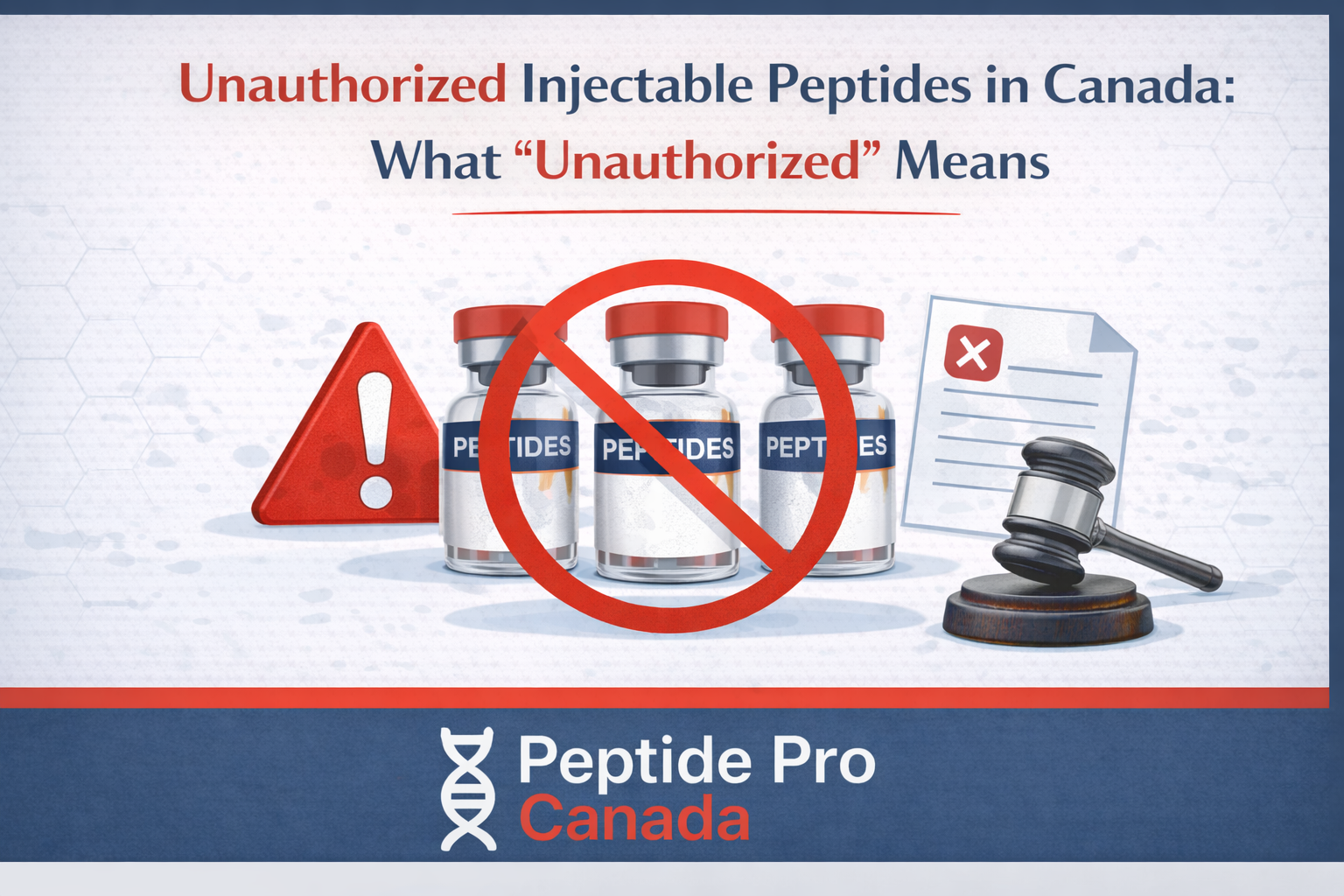
Unauthorized Injectable Peptides in Canada: What “Unauthorized” Means
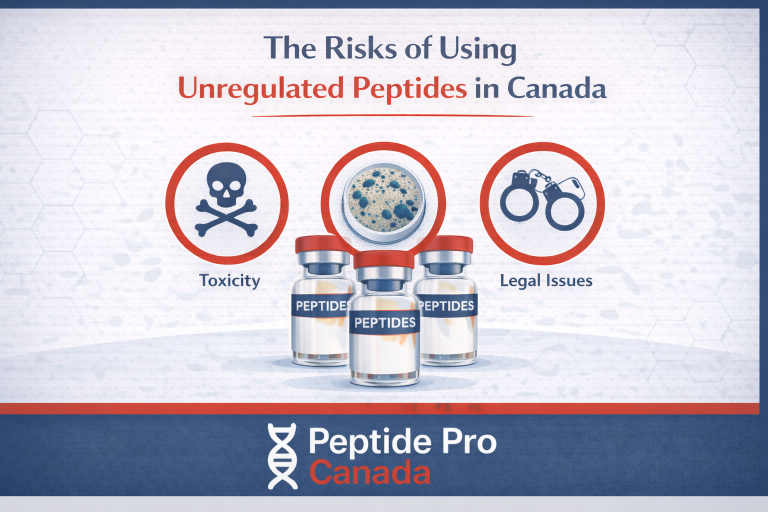
Unauthorized injectable peptides are products represented or sold as injectable peptide drugs that have not been authorized by Health Canada for sale in Canada. “Unauthorized” describes the product’s regulatory status; it does not automatically mean the product is counterfeit, but it does mean Health Canada has not authorized it for sale as a drug.
This guide explains seven critical facts about unauthorized peptide products, how Health Canada describes the category, how consumers can verify authorization, and why “Research Use Only” labelling does not create a regulatory exemption.
Important: This article provides general information and does not constitute legal, medical, or regulatory advice.
Unauthorized Injectable Peptides: Quick Answer
- “Unauthorized” means Health Canada has not authorized the product for sale in Canada as a drug or health product.
- Health Canada states that unauthorized drugs have not been assessed for safety, efficacy, and quality.
- Health Canada generally regulates injectable peptide products represented for human use as prescription drugs.
- “Research Use Only” labelling does not make an unauthorized product legal or exempt from regulatory requirements.
- A Certificate of Analysis does not replace Health Canada authorization.
- Authorized drugs generally display an eight-digit Drug Identification Number.
7 Critical Facts About Unauthorized Injectable Peptides
1. “Unauthorized” Describes Regulatory Status
When Health Canada calls a drug product unauthorized, it means the product has not received authorization for sale in Canada.
According to Health Canada, unauthorized drugs have not been assessed through its authorization process for:
- Safety
- Efficacy or effectiveness
- Quality
- Approved conditions of use
- Authorized labelling
The term does not necessarily mean that every unauthorized product is counterfeit. “Counterfeit” generally describes a fraudulent product presented as an authentic authorized product. A product can be unauthorized without copying an approved brand.
2. Injectable Peptides Receive Increased Regulatory Attention
Health Canada has issued multiple public advisories concerning unauthorized injectable peptide drugs sold online. These advisories state that injectable peptides represented for human use are regulated as prescription drugs in Canada.
Health Canada’s enforcement notices have identified products including:
- BPC-157
- CJC-1295
- DSIP
- Epitalon
- GHK-Cu
- Ipamorelin
- KPV
- Melanotan I and II
- MOTS-C
- NAD+
- Retatrutide
- SS-31
- TB-500
This list contains examples identified in enforcement actions and is not a complete list of every peptide that may be subject to Canadian requirements.
Read Health Canada’s April 2026 public advisory about unauthorized injectable peptide drugs.
3. Unauthorized Does Not Automatically Mean Fake
Authorization status and analytical identity are different questions.
- Authorization status addresses whether Health Canada has authorized the product for sale as a health product.
- Identity testing addresses whether analytical data support that a submitted sample contains the expected material.
- Purity testing reports specified analytical characteristics under the stated method.
- Counterfeit status concerns whether a product fraudulently imitates another product or misrepresents its source.
A laboratory report cannot turn an unauthorized drug into an authorized product. Likewise, the absence of Health Canada authorization does not, by itself, analytically establish what is inside a particular vial.
4. “Research Use Only” Is Not an Exemption
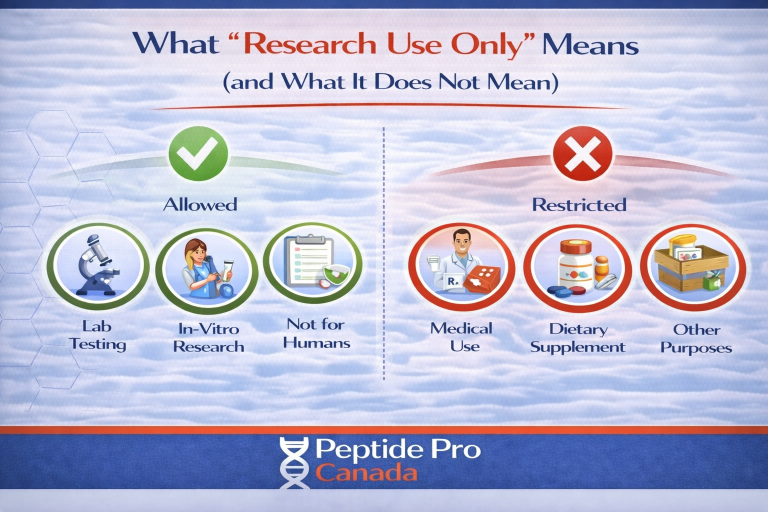
Health Canada has expressly warned that labelling a peptide product “For Research Use Only – Not for Human Consumption” does not make that product legal or exempt it from regulatory requirements.
A research-use statement communicates a claimed intended purpose, but regulators can consider the complete presentation and surrounding circumstances, including:
- Product descriptions
- Therapeutic or body-function claims
- Website and social-media content
- Published reviews and testimonials
- Instructions for personal use
- Customer-support communications
- How the product is packaged and represented
- The actual activities being conducted
A disclaimer does not neutralize conflicting human-use claims or instructions elsewhere on a website.
5. Promotion and Representation Matter
Canada’s Food and Drugs Act defines a drug broadly. It includes substances manufactured, sold, or represented for diagnosing, treating, mitigating, or preventing disease, or for restoring, correcting, or modifying organic functions in humans or animals.
Content that may create a human-use or drug representation includes:
- Weight-loss claims
- Healing or injury-recovery claims
- Anti-aging or wellness claims
- Bodybuilding or athletic-performance claims
- Expected-results timelines
- Dosing, injection, administration, or reconstitution instructions
- Protocols, cycles, or personal-use schedules
- Testimonials describing physical or therapeutic outcomes
Health Canada evaluates whether a message is promotional based on its complete content and context. No single disclaimer or wording choice necessarily determines the outcome.
Review the official Health Canada guidance on advertising and other activities.
6. Authorized Drugs Have Identifiable Authorization Information
Authorized prescription and non-prescription drug products generally display an eight-digit Drug Identification Number, commonly called a DIN.
A DIN identifies characteristics including:
- Product name
- Manufacturer
- Active ingredient
- Ingredient strength
- Dosage form
- Authorized route of administration
Consumers can search Health Canada’s official Drug Product Database to determine whether a drug has been authorized for sale.
An NPN applies to an authorized natural health product, while a DIN-HM applies to an authorized homeopathic medicine. These identifiers should not be treated as interchangeable.
7. A COA Does Not Prove Authorization
A Certificate of Analysis reports specified analytical results for the sample or batch tested. Depending on the report, it may include identity, chromatographic purity, quantity, assay, impurities, sterility, endotoxin, or other testing.
A COA does not establish:
- Health Canada authorization
- Permission to sell a product as a drug
- Clinical safety or effectiveness
- Suitability for human or veterinary use
- Compliance with every Canadian regulatory requirement
- The condition of every vial that was not tested
Analytical documentation and regulatory authorization serve different purposes and should never be presented as equivalent.
Why Health Canada Warns About Unauthorized Products
Health Canada warns that unauthorized injectable drugs can present risks because they may:
- Contain too much, too little, or none of the stated ingredient
- Contain unlisted or unknown ingredients
- Contain solvents, heavy metals, particles, or microbial contaminants
- Be poorly or incorrectly labelled
- Have been manufactured or stored improperly
- Create risks of infection or allergic reaction
- Interact with medications or other health products
These are general risks identified by Health Canada for unauthorized products. They do not constitute analytical findings about every individual product or batch.
What Health Canada Has Done
Health Canada has reported seizures and enforcement involving unauthorized injectable peptide drugs sold online by Canadian businesses. Published actions include:
- Unauthorized injectable peptides sold by Prime Research
- Unauthorized injectable peptides seized from Canada Peptide
- Health Canada’s 2026 national peptide advisory
Health Canada has also stated that it works with the Canada Border Services Agency to prevent unauthorized health-product shipments from entering Canada.
Research Materials and Human-Use Boundaries
Materials presented solely for legitimate laboratory research are not represented as suitable for human or veterinary use. They are not intended for:
- Consumption
- Injection or administration
- Diagnosis or treatment
- Personal experimentation
- Therapeutic or clinical applications
- Changing human or animal bodily functions
PeptideProCanada does not provide dosing, mixing, reconstitution, injection, administration, personal-use, cycle, or protocol guidance. Nothing on this website should be interpreted as representing a research material as an authorized health product.
How to Check Whether a Health Product Is Authorized
- Check the product label for an eight-digit DIN, NPN, or DIN-HM.
- Confirm that the number applies to the exact product, manufacturer, strength, and dosage form.
- Search the appropriate Health Canada database.
- Review the product’s current authorization status.
- Do not treat a COA, QR code, disclaimer, or seller statement as market authorization.
If you are uncertain about a product’s legal status or permitted activity, consult Health Canada or an appropriately qualified Canadian regulatory professional.
Frequently Asked Questions
What does “unauthorized” mean?
It means Health Canada has not authorized the product for sale in Canada as a drug or health product. Health Canada states that unauthorized drugs have not been assessed through its authorization process for safety, efficacy, and quality.
Does unauthorized mean counterfeit?
Not necessarily. A counterfeit product fraudulently imitates or misrepresents another product. A product can be unauthorized without copying an authorized brand.
Does “Research Use Only” make a peptide legal?
No. Health Canada states that this type of labelling does not make an unauthorized product legal or exempt it from applicable regulatory requirements.
Does a COA mean that Health Canada approved the product?
No. A COA reports specified analytical results. It is not a DIN, product licence, market authorization, or evidence of suitability for human use.
How can I check whether a drug is authorized?
Look for an eight-digit DIN and verify the exact product through Health Canada’s Drug Product Database.
What should someone do after using an unauthorized injectable product?
Health Canada advises anyone who has used an unauthorized injectable peptide drug and feels unwell or has concerns to contact a licensed healthcare professional.
Documentation and Regulatory Information
For information about analytical reports and their limitations, read our guide to reading a peptide Certificate of Analysis.
For a more detailed explanation of research-only labelling, read What “Research Use Only” Means.
Related Reading
- What “Research Use Only” Means
- Are Peptides Legal in Canada for Research Use?
- How to Read a Certificate of Analysis for Research Peptides
- Is BPC-157 Legal in Canada?
Disclaimer: This article is provided for general informational purposes only and does not constitute legal, medical, scientific, or regulatory advice. Requirements depend on the specific product, its representation, intended use, and the activities being conducted.