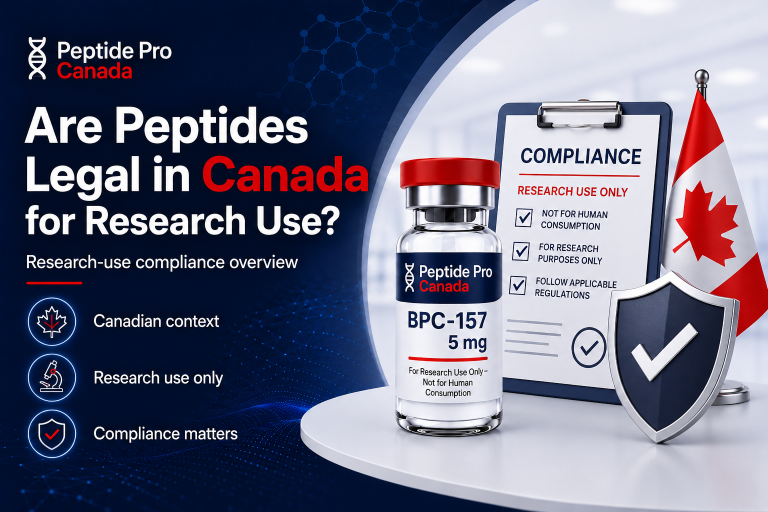
Is BPC-157 Legal in Canada for Research Use?
BPC-157 legal Canada: BPC-157 is not authorized by Health Canada as a drug for human use. Health Canada has identified BPC-157 in public advisories, seizures, enforcement actions, and a 2026 recall involving unauthorized active pharmaceutical ingredients.
The regulatory treatment of BPC-157 depends on its classification, intended use, representation, sale, importation, and surrounding activities. A “Research Use Only” label does not automatically make a product legal or exempt it from Canadian regulatory requirements.
Important: This article provides general information and does not constitute legal, medical, or regulatory advice.
BPC-157 Legal Canada: Quick Answer
- BPC-157 is not authorized by Health Canada as a drug for human use.
- Health Canada has listed BPC-157 among unauthorized injectable peptide drugs seized in Canada.
- Health Canada states that selling unauthorized drugs in Canada is illegal.
- A Research Use Only label does not create a legal or regulatory exemption.
- A Certificate of Analysis does not constitute Health Canada authorization.
- BPC-157 appears on the 2026 World Anti-Doping Agency Prohibited List.
7 Critical BPC-157 Facts in Canada
1. BPC-157 Is Not Authorized for Human Use
BPC-157 is not authorized by Health Canada as a drug for human use. It does not have an approved indication, authorized dosage form, or Health Canada-approved instructions for human administration.
Health Canada has included BPC-157 in public warnings concerning unauthorized injectable peptide drugs. According to Health Canada, unauthorized drugs have not been assessed through its authorization process for:
- Safety
- Efficacy or effectiveness
- Quality
- Approved conditions of use
- Authorized labelling
Online claims about healing, recovery, performance, or wellness should not be interpreted as Health Canada authorization or evidence of established clinical effectiveness.
2. Health Canada Has Specifically Named BPC-157
On April 9, 2026, Health Canada published a national warning concerning unauthorized injectable peptide drugs purchased online. BPC-157 was included among the examples of products seized by Health Canada.
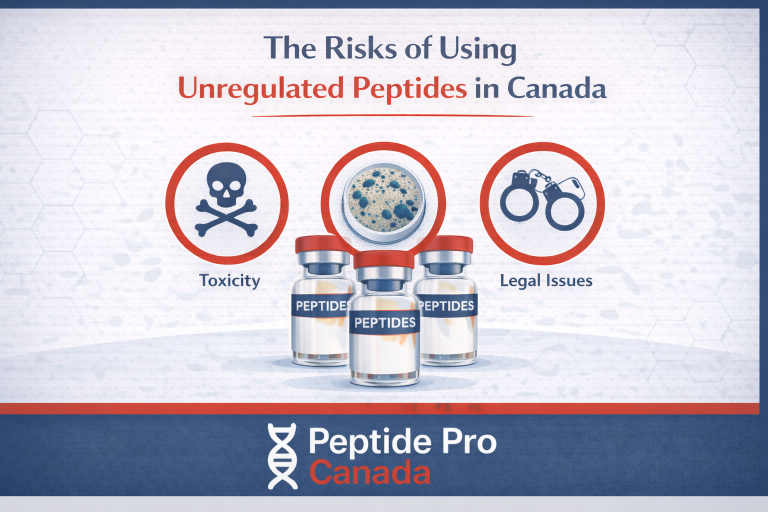
The warning states that unauthorized peptide drugs may:
- Contain too much, too little, or none of the stated ingredient
- Contain unlisted, dangerous, or unknown ingredients
- Contain solvents, heavy metals, particles, bacteria, fungi, or endotoxins
- Be poorly or incorrectly labelled
- Have been improperly manufactured or stored
- Create risks of infection, allergic reaction, or other complications
- Interact with medications or other health products
These are general risks identified by Health Canada for unauthorized products. They are not analytical findings about every individual sample or batch.
Read the complete Health Canada warning about unauthorized peptide drugs.
3. Health Canada Issued a 2026 BPC-157 Powder Recall
In May 2026, Health Canada published a recall involving BPC-157 powder and GHK-Cu powder described as unauthorized active pharmaceutical ingredients.
The recall listed BPC-157 powder in 5-gram and 50-gram quantities and identified its market authorization as not applicable. The recall was directed to compounding and community pharmacies and was classified as a Type I recall.
This is significant because Health Canada’s published actions involving BPC-157 are not limited to small online injectable vials. They have also extended to bulk powder identified as an unauthorized active pharmaceutical ingredient.
Review the official Health Canada BPC-157 powder recall.
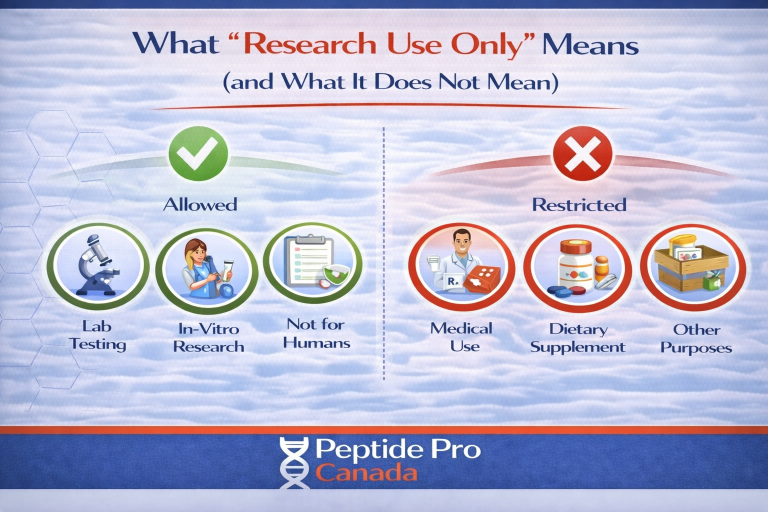
4. “Research Use Only” Does Not Create an Exemption
A Research Use Only statement does not, by itself, determine whether acquiring, possessing, importing, distributing, or selling BPC-157 complies with Canadian law.
Health Canada’s April 2026 warning specifically addresses products labelled “For Research Use Only – Not for Human Consumption” and states that this type of labelling does not make unauthorized products legal or exempt them from regulatory requirements.
Regulators may consider factors including:
- How the product is described and presented
- The direct and implied claims being made
- The product’s form, packaging, and labelling
- The intended and reasonably apparent use
- Testimonials, images, links, and surrounding content
- Whether instructions for personal use are provided
- How the product is imported, sold, or distributed
- The actual activities being conducted
A disclaimer does not necessarily correct a page whose overall presentation promotes personal, therapeutic, or clinical use.
5. Human-Use Claims Affect Regulatory Treatment
Canada’s Food and Drugs Act defines a drug broadly. It includes substances manufactured, sold, or represented for diagnosing, treating, mitigating, or preventing disease, or for restoring, correcting, or modifying organic functions in humans or animals.
Content may represent BPC-157 as a human-use drug when it discusses or promises:
- Healing or injury recovery
- Pain reduction
- Digestive or medical benefits
- Performance or body-composition changes
- Personal results or timelines
- Dosing, mixing, or reconstitution
- Injection or administration instructions
- Protocols, cycles, or personal-use recommendations
- Testimonials describing physiological outcomes
Health Canada evaluates whether content is promotional using the entire message and its context. A research disclaimer cannot be separated from conflicting claims elsewhere on the same website.
6. A COA Does Not Make BPC-157 Authorized
A Certificate of Analysis may report specified analytical results for a submitted sample or batch. Depending on the report, it may include identity, chromatographic purity, quantity, assay, impurities, sterility, endotoxin, or other testing.
A COA does not establish:
- Health Canada authorization
- Permission to sell a product as a drug
- Clinical safety or effectiveness
- Suitability for human or veterinary use
- Compliance with every applicable Canadian requirement
- The condition of every vial or unit that was not tested
Analytical documentation and regulatory authorization serve different purposes. A laboratory result cannot turn an unauthorized drug into an authorized health product.
7. BPC-157 Is Prohibited in Competitive Sport
BPC-157 appears on the World Anti-Doping Agency’s 2026 Prohibited List under section S0, Non-Approved Substances.
Section S0 covers pharmacological substances that are not addressed elsewhere on the list and are not currently approved for human therapeutic use by a government regulatory health authority. BPC-157 is specifically identified as an example.
Substances in section S0 are prohibited at all times, both in and out of competition. WADA status is separate from Health Canada authorization and Canadian sale requirements.
Athletes and support personnel should consult the official 2026 WADA Prohibited List.
How Health Canada Identifies Authorized Drugs
An authorized prescription or non-prescription drug generally displays an eight-digit Drug Identification Number, commonly called a DIN.
A DIN identifies characteristics including:
- Product name
- Manufacturer
- Active ingredient
- Ingredient strength
- Dosage form
- Authorized route of administration
Consumers can search Health Canada’s official Drug Product Database to determine whether a drug has been authorized for sale.
A batch number, QR code, Certificate of Analysis, research disclaimer, or seller statement is not a DIN or market authorization.
Previous Canadian Enforcement Actions
BPC-157 has appeared in several Health Canada notices involving unauthorized injectable peptide drugs seized from Canadian businesses.
- Unauthorized injectable peptides seized from Canada Peptide
- Unauthorized injectable peptides seized from Optimum Wellness Centre
- Health Canada’s 2026 national peptide warning
These notices address the specific products, representations, and circumstances identified by Health Canada. They demonstrate that BPC-157 sold or promoted as an injectable or human-use product can attract regulatory enforcement.
Research Materials and Human-Use Boundaries
Materials presented solely for legitimate laboratory research are not represented as suitable for human or veterinary use. They are not intended for:
- Consumption
- Injection or administration
- Diagnosis or treatment
- Personal experimentation
- Therapeutic or clinical applications
- Changing human or animal bodily functions
PeptideProCanada does not provide dosing, mixing, reconstitution, injection, administration, personal-use, cycle, or protocol guidance. Nothing on this website should be interpreted as representing BPC-157 as an authorized health product.
BPC-157 Legal Canada Frequently Asked Questions
Is BPC-157 approved for human use in Canada?
No. BPC-157 is not authorized by Health Canada as a drug for human use.
Is it legal to sell BPC-157 for injection or personal use?
Health Canada has identified BPC-157 among unauthorized injectable peptide drugs and states that selling unauthorized drugs is illegal in Canada. It must not be represented or sold as an injectable treatment, medicine, or human-use product without the required authorization.
Does “Research Use Only” make BPC-157 legal?
No. Health Canada states that this type of labelling does not make an unauthorized product legal or exempt it from Canadian regulatory requirements.
Does laboratory testing make BPC-157 authorized?
No. Analytical testing can provide information about a submitted sample or batch, but it does not constitute Health Canada authorization or establish suitability for human use.
Does “not for human consumption” create a legal exemption?
No. A disclaimer communicates a claimed intended purpose but does not override the product’s classification, representation, surrounding activities, or applicable Canadian law.
Is BPC-157 prohibited in competitive sport?
Yes. BPC-157 appears in section S0 of the 2026 WADA Prohibited List and is prohibited at all times.
Important BPC-157 Regulatory Notice
BPC-157 is not authorized by Health Canada for human use. Nothing on this website should be interpreted as medical advice, instructions for administration, or a representation that BPC-157 is approved as a health product.
Organizations conducting legitimate scientific work are responsible for obtaining independent legal and regulatory advice and confirming that their acquisition, possession, importation, handling, and research activities comply with applicable requirements.
Related Reading
- Are Peptides Legal in Canada for Research Use?
- What “Unauthorized Injectable Peptides” Means in Canada
- How to Read a Certificate of Analysis
- What “Research Use Only” Means
- COA Documentation and Help
Disclaimer: This article is provided for general informational purposes only and does not constitute legal, medical, scientific, or regulatory advice. Requirements depend on the product, its classification, intended use, representation, and the activities being conducted.