The Legal Considerations for Using Peptides in Canada
Peptides in Canada do not all share one legal classification. Their regulatory treatment can depend on the substance, product form, intended use, claims, packaging, importation, distribution, and surrounding activities.
Some peptide-based drugs are authorized by Health Canada for specific medical uses. Other peptide products sold online have been identified and seized as unauthorized drugs. Labelling a product “Research Use Only” does not automatically make it legal or exempt it from Canadian regulatory requirements.
This article provides general information only and does not constitute legal, medical, or regulatory advice.
How Peptides in Canada Are Regulated
Several Canadian laws and regulatory systems may apply to a peptide or related activity. The applicable requirements depend on what the substance is, how it is represented, and what is being done with it.
Potentially relevant areas include:
- The Food and Drugs Act and its regulations
- The Controlled Drugs and Substances Act, where applicable
- Health-product authorization and advertising requirements
- Importation and customs requirements
- Clinical-trial and research-ethics requirements
- Workplace hazardous-material and laboratory-safety rules
- Provincial, territorial, professional, or institutional requirements
The current federal Food and Drugs Act is available through the Justice Laws website.
Canada’s Definition of a Drug
The Food and Drugs Act defines “drug” broadly. The definition includes substances or mixtures manufactured, sold, or represented for use in:
- Diagnosing, treating, mitigating, or preventing a disease, disorder, abnormal physical state, or related symptoms
- Restoring, correcting, or modifying organic functions in humans or animals
- Disinfecting premises where food is manufactured, prepared, or kept
This means regulatory treatment can be influenced by how a product is described and represented—not only by the name printed on its label.
Authorized Peptide-Based Drugs
Some peptide-based prescription drugs are authorized for sale in Canada for defined medical purposes. An authorized drug generally has an eight-digit Drug Identification Number, commonly called a DIN.
Authorization applies to the specific product, manufacturer, formulation, strength, conditions of use, and approved claims. The authorization of one peptide-based drug does not automatically authorize unrelated versions sold by other businesses.
Health Canada’s Drug Product Database can be used to search for authorized drug products.
Unauthorized Peptide Drugs
An unauthorized drug has not received the required Canadian authorization for sale. Health Canada states that unauthorized drugs have not been assessed through the applicable authorization process for safety, effectiveness, and quality.
Health Canada has taken enforcement action against businesses selling unauthorized injectable peptide drugs online. Its April 2026 public warning listed examples including:
- BPC-157
- CJC-1295
- DSIP
- Epitalon
- GHK-Cu
- Ipamorelin
- KPV
- Melanotan I and II
- MOTS-C
- NAD+
- Retatrutide
- SS-31
- TB-500
Read the complete Health Canada notice:
Does “Research Use Only” Create an Exemption?
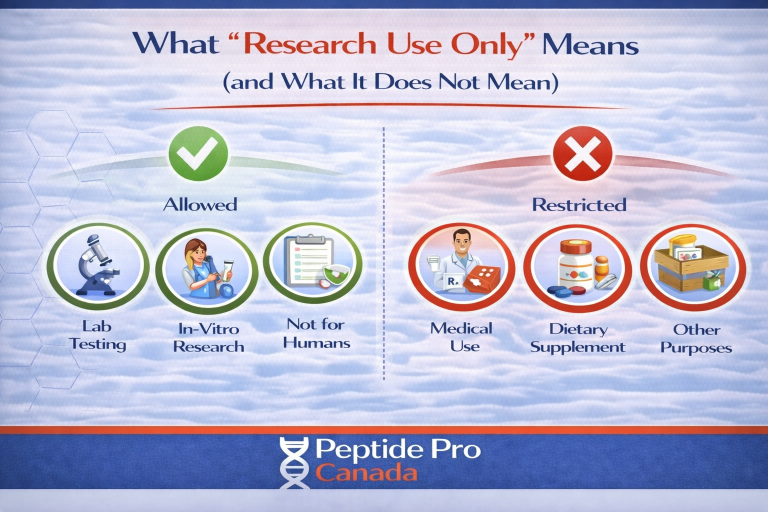
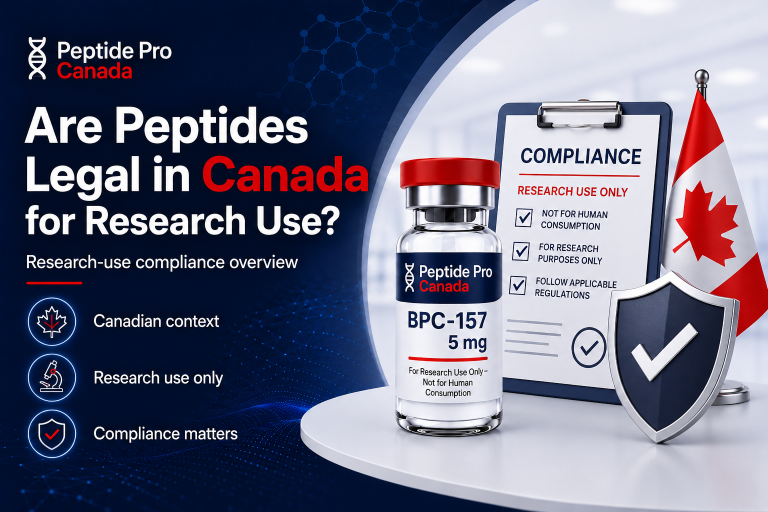
No. A “Research Use Only” or “Not for Human Consumption” statement does not automatically create a legal exemption.
Health Canada’s April 2026 warning specifically states that this type of labelling does not make unauthorized products legal or exempt them from regulatory requirements.
Regulators may consider the complete presentation and circumstances, including:
- The identity and classification of the substance
- The product’s physical form and packaging
- The claims made on the label and website
- The intended or reasonably apparent use
- Images, testimonials, links, and surrounding content
- Whether personal-use or administration information is provided
- How the material is imported, advertised, sold, or distributed
A disclaimer does not necessarily correct a product page that otherwise presents a material as a treatment, injectable product, supplement, or product intended to change human body functions.
Read our complete explanation of what “Research Use Only” means.
Legitimate Laboratory Research
Peptides are used in academic, pharmaceutical, analytical, and other scientific settings. However, describing an activity as research does not remove applicable legal or institutional obligations.
Depending on the substance and project, a research organization may need to consider:
- Institutional authorization and supervision
- Research ethics approval
- Animal-care approval
- Clinical-trial authorization
- Import permits or declarations
- Controlled-substance licensing
- Workplace health and safety requirements
- Storage, inventory, and disposal procedures
There is no universal rule stating that every peptide labelled for research may be freely acquired, imported, possessed, or distributed. Organizations should obtain qualified advice for their specific activities.
Advertising and Promotional Content
Only health products authorized by Health Canada for sale in Canada may be advertised as health products. Health Canada may intervene when an unauthorized health product is promoted.
Advertising is not limited to paid advertisements. Depending on their purpose and context, promotional material may include:
- Product pages
- Blog articles
- Social-media posts
- Emails and newsletters
- Images, videos, or audio
- Customer reviews and testimonials
- Links to personal-use information
Content creates greater regulatory risk when it discusses:
- Weight loss or body-composition outcomes
- Healing, pain, or injury recovery
- Anti-aging or wellness benefits
- Athletic or cognitive performance
- Dosing, cycles, or protocols
- Mixing, reconstitution, injection, or administration
- Personal recommendations based on symptoms or goals
- Testimonials describing physiological results
Review Health Canada’s regulatory requirements for health-product advertising.
Importation and Border Considerations
A product available from an international website is not necessarily legal to import into Canada. Shipments may be examined, detained, refused, seized, returned, or referred for regulatory review.
Import requirements can depend on:
- The identity and classification of the substance
- The product form and labelled use
- The quantity being imported
- The importer and intended recipient
- Whether a licence, permit, authorization, or prescription is required
- The accuracy of customs and shipping documentation
Purchasers and organizations should confirm import requirements before arranging an international shipment.
Certificates of Analysis and Legal Status
A Certificate of Analysis may report analytical findings for a tested sample or batch. It does not:
- Create Health Canada authorization
- Convert an unauthorized drug into an authorized product
- Establish suitability for human or veterinary use
- Replace a required licence, permit, or institutional approval
- Prove compliance with every applicable Canadian requirement
COAs support laboratory evaluation and batch traceability when they are authentic, method-specific, and connected to the correct batch. Learn more about how to read a peptide Certificate of Analysis.
Questions Researchers Should Ask
Before acquiring or working with a peptide, consider:
- What is the substance’s Canadian classification?
- Is it listed under controlled-substance legislation?
- How is the material being represented and advertised?
- What is the documented research purpose?
- Does the organization require ethics or institutional approval?
- Are import permissions or declarations required?
- Does the available documentation match the specific batch?
- Are appropriate storage, safety, and disposal procedures available?
Frequently Asked Questions
Are all peptides illegal in Canada?
No. Some peptide-based drugs are authorized for specific medical uses, and peptides may also appear in legitimate scientific research. The applicable requirements depend on the particular substance, product, representation, and activity.
Are unauthorized peptide drugs legal to sell?
No. Health Canada states that selling unauthorized drugs is illegal in Canada.
Does “Research Use Only” make any peptide legal?
No. Health Canada expressly states that research-use labelling does not automatically make an unauthorized product legal or exempt it from regulatory requirements.
Does a COA prove legal compliance?
No. A COA reports specified analytical results. It is not a market authorization, licence, legal opinion, or proof of compliance with every applicable requirement.
Can research materials be promoted for personal use?
No. A laboratory research material should not be promoted for injection, consumption, diagnosis, treatment, or any other human or veterinary application.
Where can an organization obtain definitive guidance?
Organizations should consult Health Canada, the applicable institutional authority, or a qualified Canadian legal or regulatory professional regarding their specific substance and activities.
Final Regulatory Checklist
Before acquiring or working with peptides in Canada, confirm:
- The material and intended activity have been accurately identified.
- Its regulatory and controlled-substance status has been reviewed.
- Any required licences, permits, or institutional approvals are in place.
- The material is not represented for unauthorized human use.
- Import and customs requirements have been reviewed.
- Batch-specific documentation is available.
- Appropriate storage, handling, and disposal procedures exist.
- Qualified guidance has been obtained where the legal status is uncertain.
The legal treatment of peptides in Canada cannot be determined from a product name or disclaimer alone. Substance-specific facts, representations, intended use, and the complete activity must all be considered.