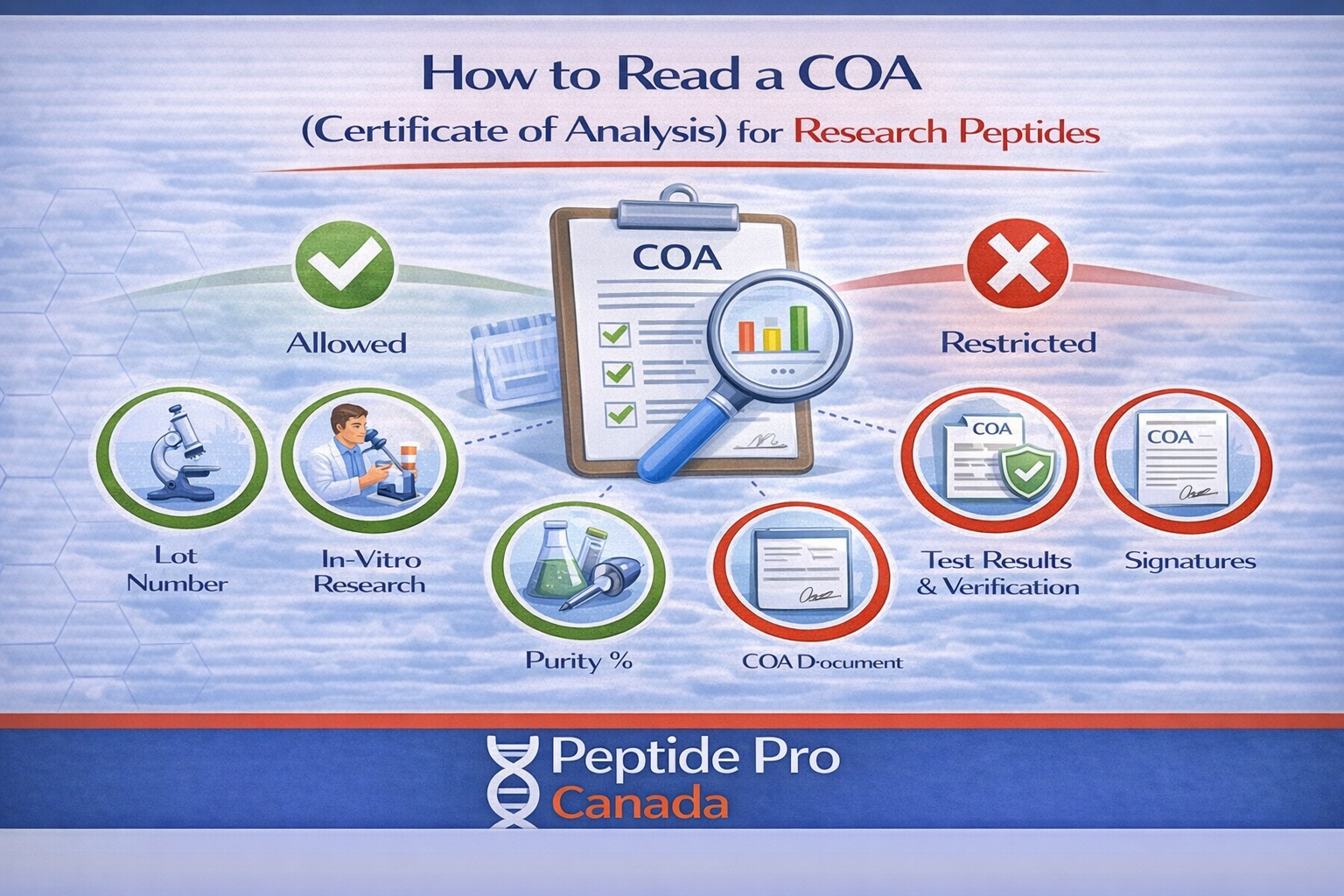
How to Read a COA (Certificate of Analysis) for Research Peptides
Research Use Only is a statement that a material is intended solely for legitimate laboratory, analytical, or scientific work. It does not mean the product is authorized by Health Canada, exempt from Canadian regulatory requirements, or suitable for use in humans or animals.
This article explains seven critical facts about the label, what it does and does not communicate, and why a product’s presentation, promotion, documentation, and intended use still matter.
Important: This article provides general information and is not legal, medical, or regulatory advice.
Research Use Only: Quick Answer
- The label describes a stated laboratory or analytical purpose.
- It does not mean Health Canada has reviewed or authorized the product.
- It does not make an unauthorized product legal or exempt from regulatory requirements.
- It does not indicate that a material is safe or suitable for human or veterinary use.
- It does not override therapeutic claims, personal-use instructions, testimonials, or other promotional content.
- Regulatory requirements depend on the material, how it is represented, and the activities being conducted.
7 Critical Research Use Only Facts
1. It Describes a Stated Intended Purpose
In plain language, the label indicates that a material is being presented for laboratory, analytical, or scientific research rather than clinical or personal use.
Appropriate research activities may include qualified laboratory analysis, method development, reference work, or other controlled scientific applications permitted under applicable requirements.
The statement should be consistent with the product’s:
- Label and packaging
- Product description
- Technical documentation
- Website content
- Advertising and social-media content
- Customer-support communications
- Actual intended use and distribution
2. It Does Not Mean Health Canada Approved
A Research Use Only label is not a Health Canada authorization, licence, approval, registration, or product identification number.
Authorized drugs sold in Canada generally carry an eight-digit Drug Identification Number, commonly called a DIN. A Certificate of Analysis, research disclaimer, batch number, or laboratory report is not a substitute for market authorization.
Health Canada maintains a searchable Drug Product Database that can be used to verify whether a drug has been authorized for sale in Canada.
3. It Does Not Create a Regulatory Exemption
Health Canada has specifically warned that labelling a product “For Research Use Only – Not for Human Consumption” does not make it legal or exempt it from regulatory requirements.
In an April 2026 public advisory concerning unauthorized peptide drugs sold online, Health Canada advised Canadians not to buy or use unauthorized drug products marketed using this type of labelling.
Read the complete Health Canada advisory concerning unauthorized peptide products.
4. It Does Not Mean Safe for Humans or Animals
Research materials offered under this designation are not represented as suitable for personal, medical, veterinary, diagnostic, or therapeutic use.
They are not intended for:
- Human or veterinary consumption
- Injection or administration
- Diagnosis, treatment, mitigation, or prevention of disease
- Changing bodily functions
- Personal experimentation
- Clinical or therapeutic applications
A product’s appearance, packaging, purity result, or Certificate of Analysis does not establish that it is safe, sterile, effective, or authorized for human use.
5. The Complete Product Presentation Matters
A disclaimer cannot be assessed in isolation from the rest of the product’s presentation. Product names, descriptions, images, reviews, blog posts, advertisements, social content, links, and customer-support statements can all affect how a product is represented.
Canada’s Food and Drugs Act defines a drug broadly. It includes substances manufactured, sold, or represented for diagnosing, treating, mitigating, or preventing disease, or for restoring, correcting, or modifying organic functions in humans or animals.
Consequently, wording that connects a research material with therapeutic effects, personal results, or changes to bodily functions can create regulatory concerns regardless of a disclaimer elsewhere on the page.
6. Educational Content Can Still Be Promotional
Calling a page “educational” does not automatically make it non-promotional. Health Canada assesses the complete message and its context when determining whether it promotes the sale of a health product.
Factors can include:
- Who created or paid for the message
- Where and how it is distributed
- The intended and actual audience
- Whether the content emphasizes a specific product
- Whether benefits are emphasized or risks minimized
- Links between educational material and product sales
- The wording, images, layout, and surrounding content
Health Canada states that each message is evaluated in its entirety and that no single factor necessarily determines whether it is promotional. Review the official guidance on advertising and other activities.
7. Documentation Does Not Replace Authorization
Batch documentation can help qualified researchers evaluate the identity, quantity, purity, or other reported analytical characteristics of a material. However, that documentation has a limited purpose.
A Certificate of Analysis does not establish:
- Health Canada approval
- Authorization for sale as a drug
- Suitability for human or veterinary use
- Clinical safety or effectiveness
- Compliance with every Canadian legal requirement
Documentation should be batch-specific, verifiable, and interpreted according to the analytical methods and limitations shown in the report.
What Research Use Only Does Not Mean
- It does not mean “approved in Canada.”
- It does not mean “legal for any purpose.”
- It does not mean “safe for humans.”
- It does not mean “pharmaceutical grade.”
- It does not authorize therapeutic or medical claims.
- It does not permit personal-use instructions.
- It does not replace substance-specific legal review.
- It does not turn an unauthorized drug into an authorized laboratory product.
Content That Creates Regulatory Risk
Statements or materials that can conflict with a research-only presentation include:
- Dosing, injection, administration, mixing, or reconstitution instructions
- Personal protocols, cycles, or schedules
- Weight-loss, healing, recovery, performance, or anti-aging claims
- Descriptions of treating medical conditions
- Expected-results timelines
- Before-and-after claims or images
- Personal-use recommendations
- Testimonials describing physical or therapeutic outcomes
A footer disclaimer does not neutralize conflicting representations elsewhere on a website.
More Appropriate Research-Supply Information
Information intended for legitimate research settings may focus on:
- Product identity and labelled quantity
- Lot and batch traceability
- Analytical methods and documentation
- How to interpret a Certificate of Analysis
- Laboratory storage and handling principles
- Shipping, packaging, and damage-reporting procedures
- Research-use restrictions and documentation limitations
Whether particular content or activity complies with Canadian law remains a case-specific question. Organizations should obtain qualified advice when the regulatory classification or permitted activity is uncertain.
Reviews and Testimonials
A published customer review becomes part of the surrounding product presentation. Reviews describing personal use, physical effects, therapeutic outcomes, dosage, or results can conflict directly with a research-only position.
Administrative reviews may discuss matters such as:
- Shipping speed
- Packaging condition
- Customer-service experience
- Ordering procedures
- Availability of batch documentation
Reviews should not be published when they describe human or veterinary use, therapeutic outcomes, personal protocols, or other prohibited applications.
Research-Only Content Checklist
- Is the intended laboratory purpose stated accurately?
- Does the page avoid claims of Health Canada approval?
- Does it avoid suggesting that the label creates a legal exemption?
- Does it avoid medical, therapeutic, performance, or body-function claims?
- Does it omit dosing, mixing, injection, and administration instructions?
- Are all published reviews limited to administrative experiences?
- Does analytical documentation match the correct lot or batch?
- Are documentation limitations explained clearly?
Frequently Asked Questions
Is Research Use Only a legal shield?
No. It is a statement of intended purpose, not a legal exemption. Health Canada has expressly stated that this type of labelling does not make an unauthorized product legal or exempt from regulatory requirements.
Does the label mean a product is authorized in Canada?
No. The statement is not evidence of Health Canada authorization, approval, licensing, or registration.
Can blog posts count as promotion?
Yes. Health Canada considers the message’s content, context, audience, sponsor, distribution, product emphasis, and surrounding links. A blog post may be promotional if its purpose or overall effect is to encourage product sales.
Does a COA prove that a material is safe for human use?
No. A Certificate of Analysis reports specific analytical results for a material or batch. It does not demonstrate regulatory authorization, clinical safety, effectiveness, or suitability for humans or animals.
Can research materials be used personally?
No. Materials presented solely for laboratory research are not intended for personal, human, veterinary, therapeutic, diagnostic, or clinical use.
Research Use Only Documentation
For help interpreting analytical documentation, visit our COA Help page and review the batch-specific reports provided on the applicable product page.
Always confirm that the product name and lot or batch number correspond to the material being evaluated.
Related Reading
- Are Peptides Legal in Canada for Research Use?
- Unauthorized Injectable Peptides in Canada: What “Unauthorized” Means
- How to Read a Certificate of Analysis for Research Peptides
- Research Peptide Glossary: COA, HPLC, LC-MS and More
Disclaimer: This information is provided for general educational purposes and does not constitute legal, medical, scientific, or regulatory advice. Requirements depend on the specific substance, representation, intended activity, and applicable law. Consult Health Canada or an appropriately qualified professional when guidance is required.