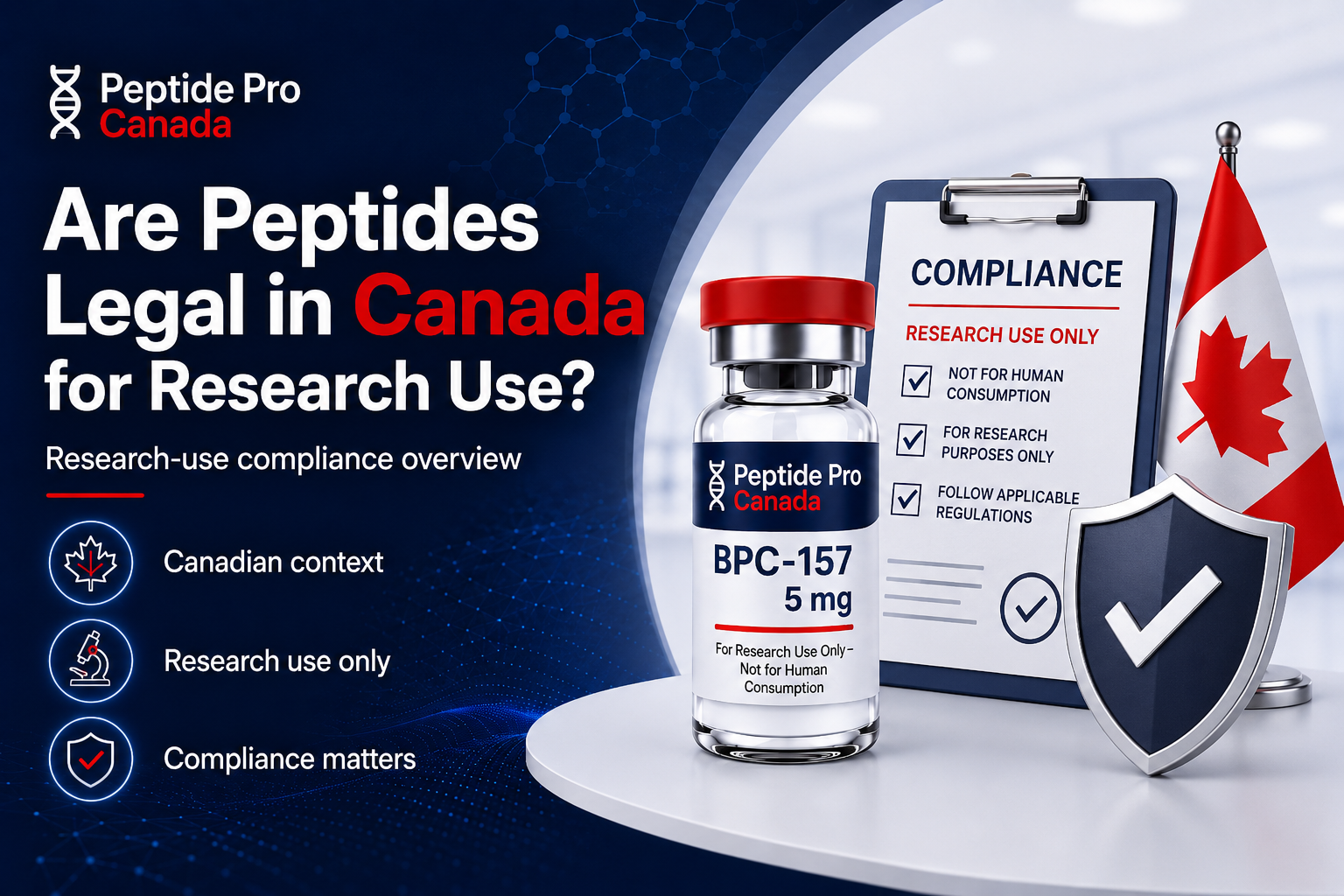
Are Peptides Legal in Canada for Research Use?
Are peptides legal in Canada? There is no single legal status covering every peptide, product, and activity. Some peptide-based drugs are authorized by Health Canada for specific medical uses, while other products promoted or sold as peptide drugs are unauthorized.
Health Canada has repeatedly taken enforcement action involving unauthorized injectable peptide products. In April 2026, Health Canada also warned that labelling a product “For Research Use Only – Not for Human Consumption” does not automatically make it legal or exempt it from Canadian regulatory requirements.
Important: This article provides general information and does not constitute legal, medical, or regulatory advice.
Are Peptides Legal in Canada? Quick Answer
- Some peptide-based drugs are authorized for specific medical purposes.
- Other products sold or promoted as peptide drugs are unauthorized.
- Health Canada states that selling unauthorized drugs in Canada is illegal.
- Health Canada has seized numerous unauthorized injectable peptide drugs sold online.
- A Research Use Only label does not create a blanket legal exemption.
- Classification can depend on the substance, product form, presentation, claims, intended use, and surrounding activities.
- Organizations conducting scientific research must determine which laws, licences, authorizations, and institutional requirements apply.
7 Critical Facts About Peptides in Canada
1. Not Every Peptide Has the Same Legal Status
The question “Are peptides legal in Canada?” cannot be answered with a universal yes or no. Peptides are a broad category of substances, and different products can have different classifications, authorizations, and restrictions.
Relevant factors may include:
- The identity of the substance
- Whether it is included in a prescription-drug listing
- The product’s physical form
- How it is labelled and packaged
- The claims made about it
- Its intended or reasonably apparent use
- Whether it is imported, manufactured, sold, or distributed
- Whether human or animal research is involved
The status of one authorized peptide drug does not establish the status of every other peptide product.
2. Canadian Law Defines “Drug” Broadly
Canada’s Food and Drugs Act defines a drug broadly. The definition includes substances or mixtures of substances manufactured, sold, or represented for use in:
- Diagnosing, treating, mitigating, or preventing a disease, disorder, abnormal physical state, or related symptoms
- Restoring, correcting, or modifying organic functions in humans or animals
- Disinfecting premises where food is manufactured, prepared, or kept
Because this definition considers how a substance is sold or represented, classification can be affected by product descriptions, claims, testimonials, imagery, instructions, links, and surrounding website content.
The current definition can be reviewed in the official Food and Drugs Act.
3. Some Peptide Drugs Are Authorized
Some peptide-based prescription drugs have been authorized by Health Canada for specific medical indications. Authorized drugs generally have an eight-digit Drug Identification Number, commonly called a DIN.
A DIN identifies characteristics including:
- The product name
- The manufacturer
- The active ingredient
- The ingredient strength
- The dosage form
- The authorized route of administration
An authorization applies to the specific product, manufacturer, formulation, strength, dosage form, and approved conditions. It should not be assumed to cover unrelated products containing a similarly named substance.
4. Unauthorized Peptide Drugs Cannot Be Sold as Authorized Health Products
An unauthorized peptide drug has not received the required authorization for sale in Canada. Health Canada states that unauthorized drugs have not been assessed through its authorization process for safety, effectiveness, and quality.
Health Canada has repeatedly stated that selling unauthorized drugs in Canada is illegal.
Unauthorized does not necessarily mean counterfeit. A product can be unauthorized without fraudulently copying an approved brand. However, neither an unauthorized nor counterfeit drug should be represented as an authorized Canadian health product.
5. “Research Use Only” Does Not Create an Exemption
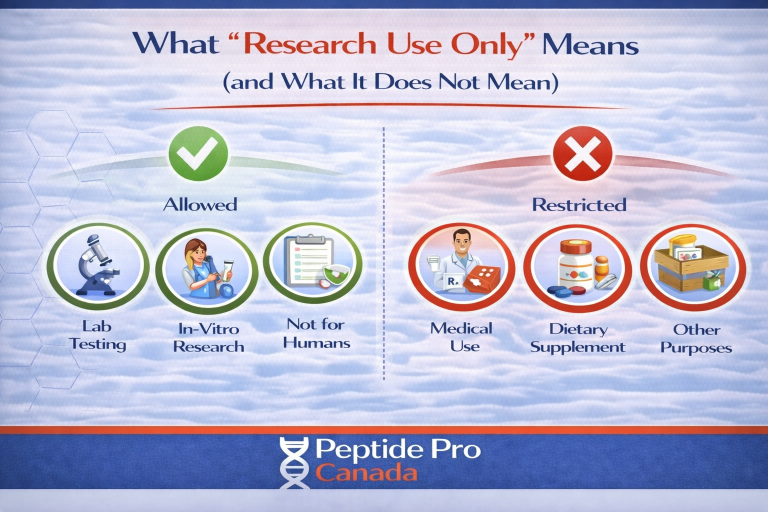
A Research Use Only label communicates a claimed intended purpose, but it does not automatically answer whether peptides are legal in Canada for a particular activity.
Health Canada’s April 2026 advisory specifically states that labelling products “For Research Use Only – Not for Human Consumption” does not make them legal or exempt them from regulatory requirements.
A regulator may examine the complete circumstances, including:
- The substance’s identity and classification
- The product’s form, packaging, and labelling
- The claims and descriptions being used
- The intended or reasonably apparent use
- The audience and sales channel
- Images, testimonials, links, and surrounding content
- Whether administration or personal-use instructions are provided
- How the material is imported, possessed, distributed, or sold
A disclaimer cannot necessarily correct a product presentation that otherwise promotes injection, consumption, treatment, or another human-use purpose.
6. Advertising and Website Content Matter
Health Canada defines advertising broadly as a representation made for the purpose of directly or indirectly promoting the sale or disposal of a drug or other regulated product.
Advertising is not limited to paid advertisements. Depending on their purpose and context, promotional content may include:
- Product descriptions
- Blog articles
- Social-media posts
- Email campaigns
- Customer reviews and testimonials
- Images, videos, and audio recordings
- Links to human-use or personal-use information
- Customer-support communications
Health Canada considers multiple factors when determining whether material is informational or promotional. Each message is evaluated in its entirety and within its surrounding context.
Review the official Health Canada guidance on advertising and other activities.
7. A COA Does Not Establish Legal Authorization
A Certificate of Analysis reports specified analytical results for a submitted sample or batch. Depending on the report, it may address identity, chromatographic purity, quantity, assay, impurities, sterility, endotoxin, or other analytical characteristics.
A COA does not establish:
- Health Canada authorization
- Permission to sell a product as a drug
- Clinical safety or effectiveness
- Suitability for human or veterinary use
- Compliance with every Canadian legal requirement
- The results of tests that were not performed
Analytical testing and regulatory authorization serve different purposes. A batch report, purity result, QR code, or laboratory name is not a DIN or product licence.
Health Canada’s 2026 Peptide Warning
On April 9, 2026, Health Canada published a national warning concerning unauthorized injectable peptide drugs purchased online.
The notice listed examples of seized products including:
- BPC-157
- CJC-1295
- DSIP
- Epitalon
- GHK-Cu
- Ipamorelin
- KPV
- Melanotan I and II
- MOTS-C
- NAD+
- Retatrutide
- SS-31
- TB-500
Health Canada warned that unauthorized peptide drugs may:
- Contain too much, too little, or none of the stated ingredient
- Contain unlisted, dangerous, or unknown ingredients
- Contain solvents, heavy metals, particles, bacteria, fungi, or endotoxins
- Be poorly or incorrectly labelled
- Have been improperly manufactured or stored
- Create risks of infection, allergic reaction, or other complications
These are general risks identified for unauthorized products. They do not constitute analytical findings about every individual product or batch.
Read the complete Health Canada warning about unauthorized peptide drugs.
Legitimate Laboratory Research
Peptides are used in academic, pharmaceutical, analytical, and other scientific research. However, describing an activity as research does not remove applicable legal or institutional obligations.
Depending on the substance and activity, researchers and organizations may need to consider:
- Institutional approval and oversight
- Import and customs requirements
- Controlled-substance requirements
- Laboratory safety and chemical-handling procedures
- Human or animal research ethics approval
- Health-product and clinical-trial requirements
- Provincial, municipal, workplace, or professional rules
- Recordkeeping, storage, and disposal requirements
Organizations should obtain qualified legal or regulatory advice before acquiring or working with a material when its status is uncertain.
Content That Creates Human-Use Implications
Content may create the impression that a research material is being promoted as a health product when it discusses:
- Weight loss or body-composition changes
- Healing, recovery, or pain reduction
- Anti-aging or wellness outcomes
- Athletic or cognitive performance
- Dosing, mixing, or reconstitution instructions
- Injection or administration
- Protocols, cycles, or treatment timelines
- Personal testimonials describing physiological results
- Recommendations based on a person’s symptoms or goals
Materials presented solely for laboratory research must not be represented as treatments, medicines, supplements, injectable products for personal use, or products intended for human or veterinary administration.
How to Check Whether a Health Product Is Authorized
Authorized Canadian health products generally display an identifying number appropriate to their classification:
- DIN: Drug Identification Number
- NPN: Natural Product Number
- DIN-HM: Homeopathic Medicine Number
Use the applicable Health Canada database to verify the exact product:
Confirm that the authorization number applies to the exact manufacturer, product, ingredient, strength, and dosage form. A number belonging to another product does not provide authorization.
Frequently Asked Questions
Are all peptides illegal in Canada?
No. Some peptide-based drugs are authorized for specific medical purposes. The relevant question is whether a particular product and activity comply with the requirements applicable to its classification, representation, and intended use.
Are unauthorized peptide drugs legal to sell?
No. Health Canada states that selling unauthorized drugs in Canada is illegal.
Does Research Use Only automatically make a product legal?
No. Health Canada expressly states that research-use labelling does not automatically make an unauthorized product legal or exempt it from regulatory requirements.
Can a blog post or review count as advertising?
Potentially. Health Canada considers the purpose, content, context, audience, sponsorship, links, and surrounding presentation when determining whether a message directly or indirectly promotes a product’s sale.
Does laboratory testing authorize a peptide for human use?
No. Testing may provide analytical information about a submitted sample or batch, but it is not Health Canada authorization and does not establish clinical suitability.
Can research materials be injected or consumed?
No. Materials supplied solely for laboratory research are not intended for injection, consumption, human or veterinary use, diagnosis, treatment, or any clinical application.
Where can I verify an authorized drug?
Search Health Canada’s Drug Product Database and verify that the DIN applies to the exact product, manufacturer, strength, and dosage form.
Important Regulatory Notice
No product or statement on this website should be interpreted as medical advice, administration guidance, or a representation that an unauthorized peptide is approved for human use.
PeptideProCanada does not provide dosing, mixing, reconstitution, injection, administration, personal-use, cycle, or protocol guidance.
Purchasers and research organizations are responsible for determining whether their acquisition, possession, importation, handling, and intended activities comply with applicable Canadian requirements.
Related Reading
- What “Unauthorized Injectable Peptides” Means in Canada
- Is BPC-157 Legal in Canada?
- How to Read a Certificate of Analysis
- What “Research Use Only” Means
- COA Documentation and Help
Disclaimer: This article is provided for general informational purposes only and does not constitute legal, medical, scientific, or regulatory advice. Requirements depend on the substance, product, representation, intended use, and activities being conducted.