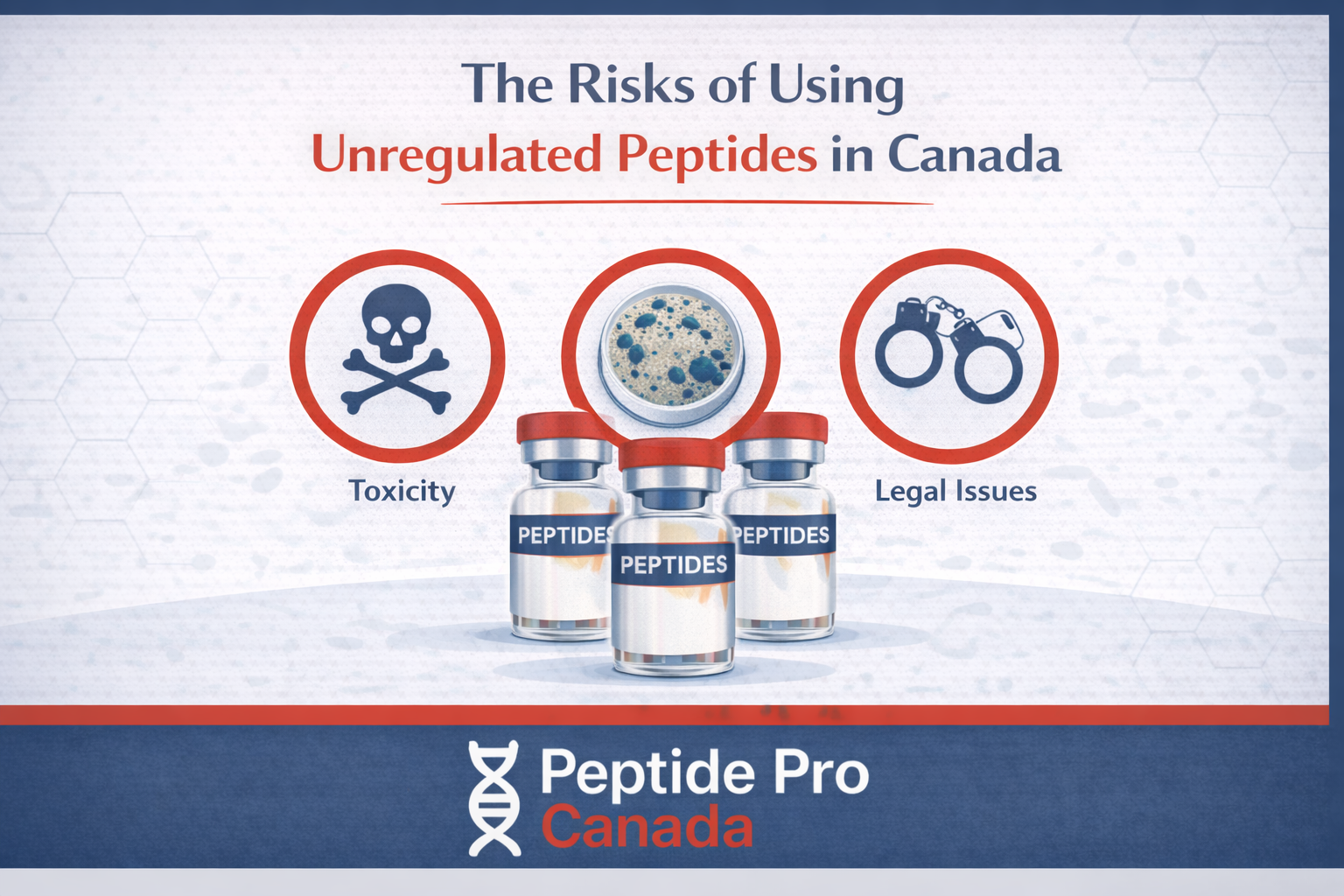
The Risks of Using Unregulated Peptides in Canada
Unregulated peptides may present significant problems for laboratory researchers when their identity, quantity, purity, testing history, or storage conditions cannot be verified. Incomplete documentation can compromise experimental reliability and make unexpected results difficult to investigate.
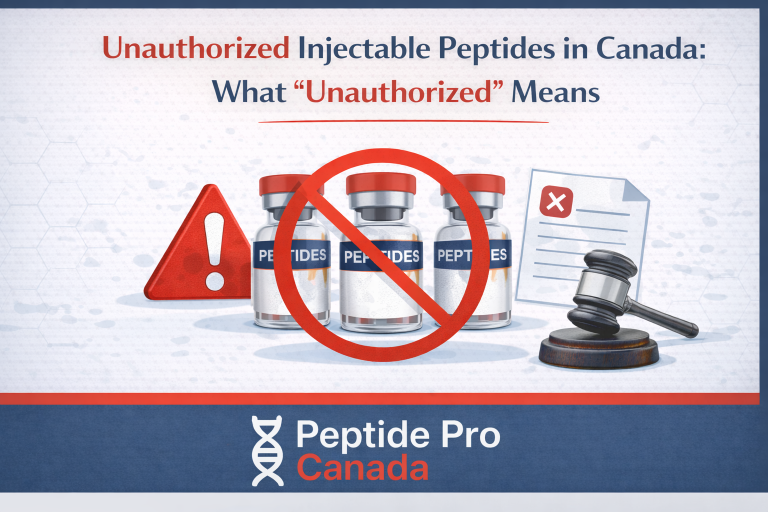
“Unregulated” is an informal term rather than one universal Canadian product classification. A more precise regulatory question is whether a particular product or activity is authorized and compliant with the requirements that apply to it.
This article provides general laboratory and regulatory information only. It does not constitute legal, medical, or regulatory advice.
What Are Unregulated Peptides?
The phrase “unregulated peptides” is commonly used to describe peptide products sold without clear regulatory authorization, reliable batch documentation, transparent testing, or appropriate quality controls.
However, legal status cannot be determined from a product name alone. Canadian requirements may depend on:
- The identity and classification of the substance
- The product’s physical form and packaging
- How the product is represented and advertised
- Its intended or reasonably apparent use
- How it is imported, possessed, distributed, or sold
- Whether the substance is controlled or otherwise restricted
- The activities being conducted by the purchaser or organization
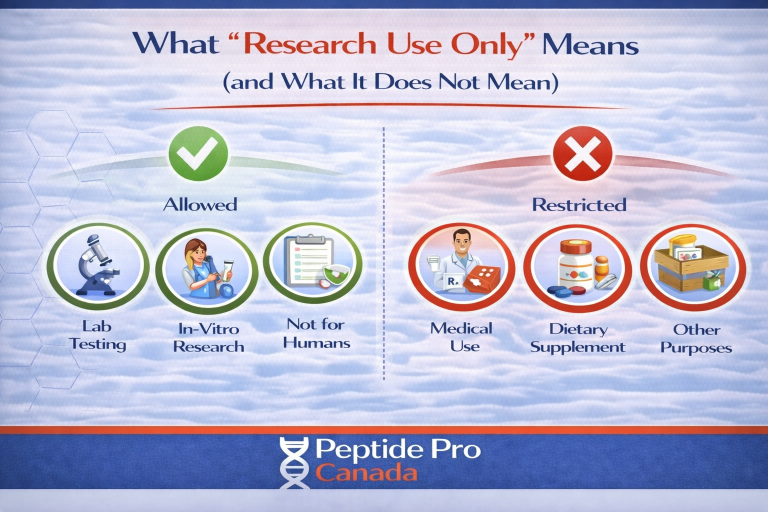
A laboratory reagent is not automatically an authorized health product. Likewise, calling something a research material does not automatically exempt it from Canadian regulatory requirements.
Unauthorized Health Products and Research Labels
Health Canada has repeatedly warned about unauthorized injectable peptide drugs sold online. In April 2026, Health Canada specifically addressed products labelled “For Research Use Only – Not for Human Consumption.”
Health Canada states that this type of labelling does not make an unauthorized product legal or exempt it from regulatory requirements.
The complete presentation matters. Regulators may consider product claims, packaging, testimonials, images, instructions, website content, and the relationship between the message and the sale.
Read the current Health Canada warning:
Research Risks Associated With Poorly Documented Peptides
From a laboratory perspective, the most immediate concern is whether the material can be adequately characterized and traced. A product may have an accurate label while still lacking enough information for a particular research project.
Incorrect Identity
The vial may not contain the compound identified on the label. Identity testing, such as an appropriate mass-spectrometry method, can provide evidence about the tested sample.
Visual appearance cannot establish peptide identity.
Unexpected Purity
The tested sample may contain impurities, degradation products, synthesis-related materials, or other detectable components. Chromatographic purity can provide useful information, but it must be interpreted according to the method used.
A high HPLC purity percentage does not automatically establish identity, total peptide quantity, sterility, endotoxin status, or heavy-metal content.
Incorrect Quantity
The amount of peptide in a vial may differ from the labelled quantity. Peptide quantity and chromatographic purity are separate measurements and should not be treated as interchangeable.
Incomplete Contaminant Testing
A report showing identity or purity does not establish that other testing was completed. Heavy metals, endotoxins, microbial contamination, and sterility require separate methods.
Researchers should not infer an unreported result from an unrelated test.
Batch Variation
Results from one lot do not necessarily represent another. Raw materials, synthesis, purification, lyophilization, packaging, transportation, and storage may vary between batches.
Documentation should correspond to the actual batch being studied.
Storage and Transportation Problems
Heat, moisture, light, damaged packaging, and repeated temperature changes may affect some research materials. The impact depends on the specific compound, packaging, exposure conditions, and available stability information.
A package arriving warm does not, by itself, prove degradation. Researchers need material-specific information and a documented storage history.
What a Certificate of Analysis Can Establish
A Certificate of Analysis reports specified analytical findings for a particular sample or batch. Depending on the report, it may include:
- Sample or batch identity
- Observed molecular mass
- Chromatographic purity
- Peptide quantity or mass
- Assay or net peptide content
- Heavy-metal results
- Endotoxin results
- Sterility results
A COA is useful only within the limits of the testing performed. It does not automatically:
- Prove that every vial in the batch is identical
- Confirm tests that are not listed
- Guarantee storage conditions after testing
- Establish suitability for human or veterinary use
- Constitute Health Canada authorization
- Prove compliance with every applicable Canadian requirement
Learn more in our guide to reading a peptide Certificate of Analysis.
How Researchers Can Evaluate Documentation
Before acquiring a material for legitimate laboratory research, review:
- The complete product name and peptide sequence
- The labelled quantity and physical form
- The lot or batch number
- The corresponding batch-specific COA
- The identity of the testing laboratory
- The test methods and reported units
- The report date and unique identifier
- The availability of independent report verification
- The storage and transportation information
- The supplier’s contact details and written policies
Researchers can review PeptidePro Canada’s available documentation through our Certificates of Analysis page.
Warning Signs in Peptide Documentation
Documentation deserves closer review when:
- The report has no batch number.
- The batch number does not match the vial.
- The laboratory cannot be identified.
- The report has no date or unique identifier.
- The analytical methods are not stated.
- The report uses unclear units or unexplained results.
- The same report is used for multiple unrelated batches.
- A purity result is presented as proof of every quality characteristic.
- The report cannot be verified with the named laboratory.
- The supplier claims that a COA constitutes Health Canada approval.
Independent Testing and Sample Selection
Independent testing can reduce reliance on unverified supplier-generated claims. However, researchers should still examine who selected the sample, how it was submitted, what methods were used, and whether the report corresponds to the batch being purchased.
Testing one vial provides information about that tested sample. Testing multiple independently selected vials may provide additional information about variation within a batch, but no sampling plan can establish that every vial is identical.
Regulatory and Advertising Concerns
Only health products authorized by Health Canada for sale in Canada may be advertised as health products. Human-use claims can include direct or indirect references to:
- Weight loss or body-composition changes
- Healing, pain reduction, or injury recovery
- Anti-aging or wellness effects
- Athletic or cognitive performance
- Dosing, cycles, or protocols
- Mixing, injection, or administration
- Personal testimonials describing physiological results
A research-use disclaimer does not necessarily correct surrounding content that presents the material as a treatment or personal-use product.
Review Health Canada’s regulatory requirements for health-product advertising.
Research-Use Restrictions
PeptidePro Canada products are supplied exclusively as laboratory research materials. They are not intended for human or veterinary use, consumption, injection, diagnosis, treatment, or any clinical application.
Researchers and organizations are responsible for determining which legal, regulatory, institutional, safety, importation, and disposal requirements apply to their activities.
Frequently Asked Questions
Does “unregulated” automatically mean counterfeit?
No. “Unregulated,” “unauthorized,” and “counterfeit” describe different concerns. A product can lack authorization without being counterfeit, but unauthorized status should not be interpreted as evidence of quality, safety, or legal compliance.
Does a COA make an unauthorized product legal?
No. A COA reports analytical results. It is not a licence, market authorization, legal opinion, or Health Canada approval.
Does high purity mean the vial contains the correct amount?
Not necessarily. Purity and quantity are different measurements. Both should be reviewed when available.
Can one report represent every batch?
No. A COA should be matched to the specific batch tested. Documentation from another batch should not be presented as current batch-specific evidence.
Can appearance confirm peptide quality?
No. Colour, texture, and lyophilized cake appearance cannot confirm identity, purity, quantity, sterility, or contaminant levels.
Final Research Checklist
Before relying on a research peptide, confirm:
- The material and batch are clearly identified.
- The COA matches the batch.
- The laboratory and report can be verified.
- The methods address the characteristics relevant to the research.
- Unreported tests are not being implied.
- Storage and handling information is available.
- The material is not represented for unauthorized human use.
- The organization has reviewed the requirements applicable to its work.
Careful evaluation of unregulated peptides and poorly documented research materials helps protect batch traceability, experimental reliability, and responsible laboratory practice.