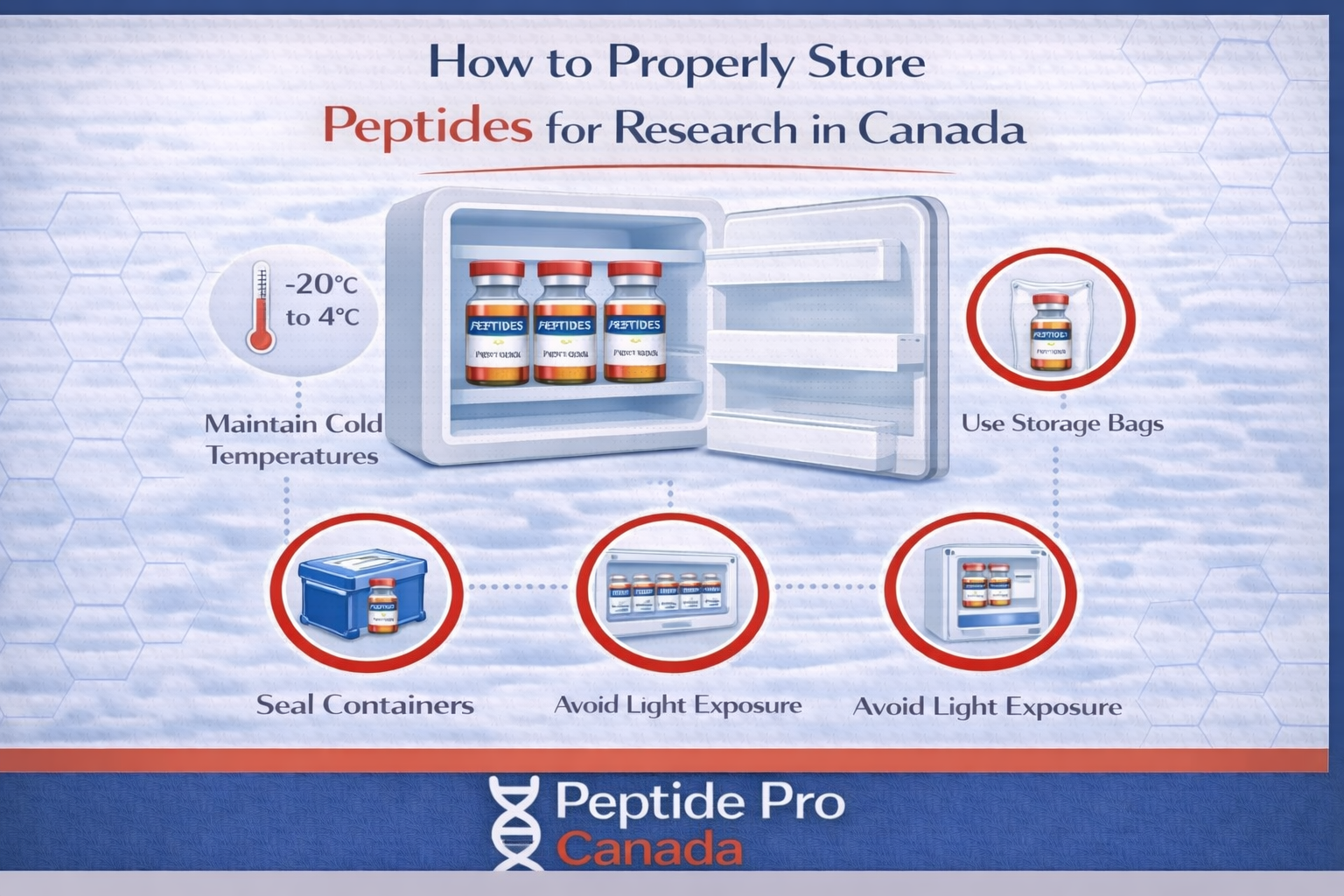
How to Properly Store Peptides for Research in Canada
Store peptides for research according to the documented requirements for the specific material, formulation, and batch. Temperature, moisture, light exposure, packaging integrity, and storage history can all influence the reliability of laboratory materials.
There is no universal storage temperature appropriate for every peptide. Researchers should rely on material-specific documentation, an approved laboratory procedure, and an appropriate risk assessment rather than applying one storage rule to every product.
This article provides general laboratory information only. It does not provide medical, clinical, or personal-use guidance.
How to Store Peptides for Research
Proper storage begins before a vial enters a refrigerator, freezer, cabinet, or controlled storage area. The laboratory must first confirm the material’s identity, batch number, physical condition, documented storage requirements, and intended analytical use.
Before storing a research peptide, review:
- The product name and labelled quantity
- The lot or batch number
- The supplier’s documented storage information
- Available technical and safety documentation
- The Certificate of Analysis
- The condition of the vial, closure, crimp, and label
- The laboratory’s approved storage procedure
1. Follow Material-Specific Temperature Requirements
Different peptides may have different stability profiles. Storage requirements can depend on the peptide sequence, physical form, formulation, packaging, moisture content, and available stability information.
Avoid assuming that every peptide must be stored at the same refrigerated or frozen temperature. Extremely cold storage is not automatically better for every material, particularly when repeated removal creates condensation or temperature cycling.
The laboratory should establish and document:
- The approved storage temperature or temperature range
- Whether short-term and long-term conditions differ
- The acceptable duration outside controlled storage
- The procedure for recording temperature deviations
- The response required after an equipment failure
2. Keep Lyophilized Materials Dry
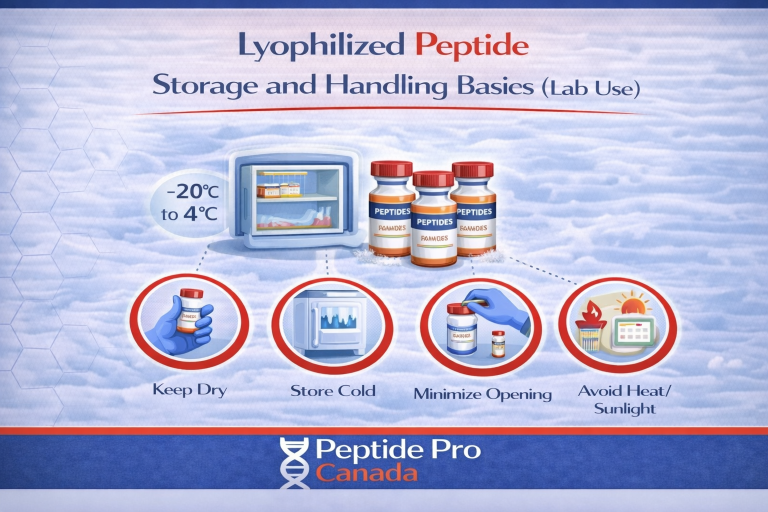
Lyophilized materials are freeze-dried to remove much of their water content. This may improve stability, but it does not make the material resistant to moisture, heat, contamination, or every form of degradation.
Condensation can form when a cold vial is exposed to warmer, humid air. Researchers should use controlled procedures that minimize moisture exposure and avoid opening cold containers prematurely.
General dry-storage principles include:
- Keep the original container securely closed.
- Do not open a vial until required for approved laboratory work.
- Avoid storing vials in wet or uncontrolled environments.
- Keep storage areas clean and free from condensation.
- Do not use a vial with a damaged or compromised closure.
Read our complete guide to lyophilized peptide storage and handling for additional information.
3. Limit Unnecessary Temperature Cycling
Repeated movement between cold and warm environments may place unnecessary stress on a sample and increase the likelihood of condensation. Laboratories should organize inventory so materials are not repeatedly removed simply to locate or identify another vial.
Good inventory organization can reduce temperature cycling by:
- Assigning each material a documented storage location
- Using clearly labelled racks or storage boxes
- Maintaining a searchable inventory record
- Planning work before opening the storage unit
- Removing only the material required for the scheduled work
Any temperature deviation should be documented. The laboratory should not assume that an exposure either caused or did not cause degradation without appropriate supporting information.
4. Protect Materials From Light
Some laboratory materials may be sensitive to ultraviolet or visible light. When light sensitivity is documented, use the protective packaging and storage conditions specified for that material.
If the sensitivity profile is unknown, avoid unnecessary exposure to direct sunlight and intense laboratory lighting. Do not remove protective packaging unless required for identification or approved laboratory work.
5. Inspect Packaging Before Storage
Examine every shipment before placing it into inventory. Look for:
- Cracked or damaged glass
- A loose or damaged crimp
- A compromised stopper or closure
- Moisture inside a vial expected to contain dry material
- An unreadable or missing product label
- A batch number that does not match the documentation
- Visible shipping damage or evidence of opening
Do not store a damaged vial with usable inventory. Isolate it according to the laboratory’s procedure, photograph the condition, retain the packaging, and contact support.
6. Maintain Complete Batch Traceability
Storage records should connect each vial to its product identity, batch documentation, and handling history. This helps researchers determine which material was used and whether any storage event could have affected the work.
Record:
- Product name
- Lot or batch number
- Date received
- Condition on arrival
- Storage location
- Documented storage temperature
- Date placed into storage
- Relevant removal and return times
- Temperature alarms or deviations
- Personnel responsible for each handling event
Review the corresponding report through our Certificates of Analysis page and confirm that it matches the batch being studied.
7. Monitor Storage Equipment
Cold-storage equipment used for laboratory materials should be appropriate for its purpose and monitored according to institutional procedures.
Depending on the laboratory and material, controls may include:
- Routine temperature checks
- Calibrated monitoring devices
- Minimum and maximum temperature records
- High- and low-temperature alarms
- Restricted access
- Backup power or alternate storage arrangements
- A documented response to equipment failure
Household refrigerators or freezers may experience greater temperature variation than purpose-designed laboratory equipment. The appropriate equipment must be determined through the laboratory’s risk assessment and storage requirements.
8. Review Safety and Handling Documentation
Storage decisions should consider both sample integrity and workplace safety. Where applicable, review the label, technical information, Safety Data Sheet, and institutional requirements.
The Canadian Centre for Occupational Health and Safety explains that safety documentation provides information about product hazards and appropriate precautions. Consult the CCOHS Safety Data Sheet guidance for general Canadian workplace information.
Not every research material is classified identically. Laboratories must determine which requirements apply to the specific substance and activity.
Common Peptide Storage Mistakes
- Applying one temperature rule to every peptide
- Ignoring material-specific documentation
- Opening cold vials in uncontrolled humid air
- Repeatedly moving samples between storage temperatures
- Leaving vials in vehicles, sunlight, or near heat sources
- Using an unmonitored household appliance for critical inventory
- Storing damaged containers with usable materials
- Separating vials from their batch documentation
- Failing to record temperature deviations
- Assuming appearance confirms identity, purity, or stability
Does a Warm Shipment Mean the Material Has Degraded?
No. The temperature of a package at delivery does not, by itself, establish degradation. The effect of an exposure depends on the material, packaging, temperature, duration, and available stability information.
If a shipment arrives damaged, wet, opened, or under unusual conditions, document the package before discarding anything. Review our shipping and returns information and contact support with the order number, tracking number, photographs, and a description of the concern.
Frequently Asked Questions
Should all research peptides be frozen?
No. Storage requirements vary. Follow the documented conditions for the specific material rather than assuming freezing is appropriate for every peptide.
Why is moisture control important?
Moisture can affect dry laboratory materials and may be introduced through damaged packaging, uncontrolled humidity, or condensation on cold containers.
Can appearance confirm that a peptide was stored correctly?
No. Appearance alone cannot confirm identity, purity, quantity, or stability. Analytical testing and documented storage history provide more meaningful information.
What should happen after a temperature alarm?
Follow the laboratory’s deviation procedure. Record the temperature, duration, affected inventory, equipment status, and corrective action. Isolate affected material when required until its status can be evaluated.
How long can a peptide remain outside controlled storage?
There is no universal answer. It depends on the specific material, temperature, duration, packaging, and available stability documentation.
Final Storage Checklist
Before placing a peptide into laboratory storage, confirm:
- The product and batch have been identified.
- The container and label are undamaged.
- The storage requirements have been reviewed.
- The correct storage location has been assigned.
- The temperature-monitoring system is working.
- The batch documentation is accessible.
- The inventory record has been updated.
- A deviation and equipment-failure procedure is available.
Researchers who properly store peptides for research can reduce preventable handling errors, maintain batch traceability, and better protect the integrity of laboratory work.