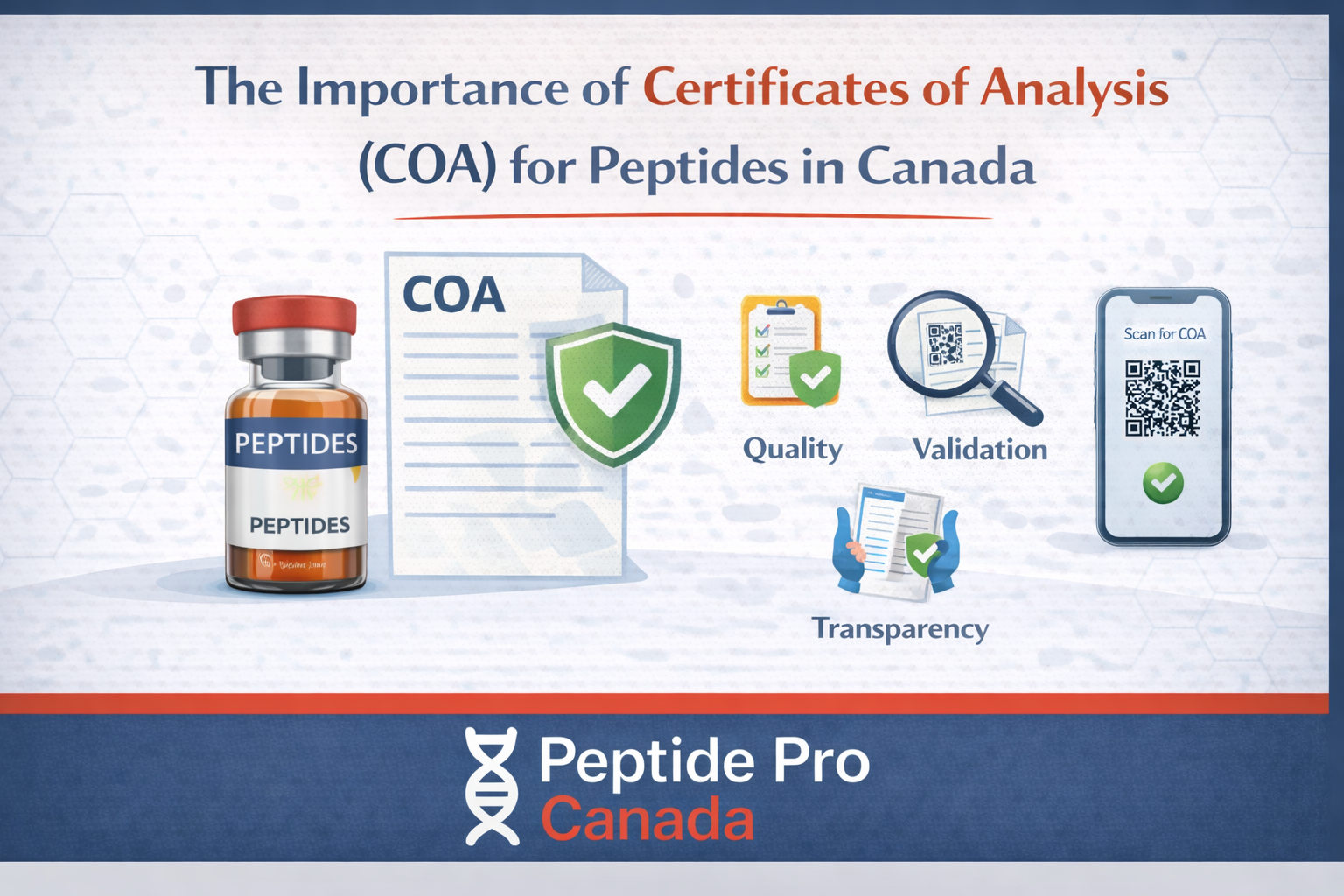
The Importance of Certificates of Analysis (COA) for Peptides in Canada
Peptide Certificates of Analysis provide laboratory results for a tested sample or batch. They can help researchers evaluate identity, quantity, purity, and other reported characteristics, but their value depends on the testing methods, laboratory, sample, and traceability information provided.
A Certificate of Analysis does not automatically prove that a material is safe, sterile, legally compliant, or authorized by Health Canada. Researchers must understand exactly what was tested—and what was not.
This article provides general laboratory information only and does not constitute legal, medical, or regulatory advice.
What Are Peptide Certificates of Analysis?
A Certificate of Analysis, commonly called a COA, is a document reporting analytical results for a particular sample, lot, or batch. It may be prepared by a manufacturer, supplier, or independent testing laboratory.
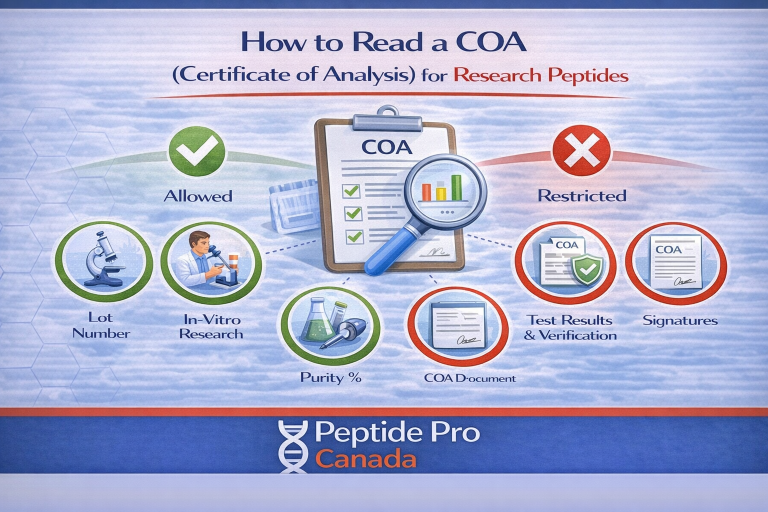
A useful peptide COA should identify:
- The material or peptide tested
- The lot or batch number
- The sample or report identifier
- The laboratory that performed the analysis
- The date the sample was received or tested
- The analytical methods used
- The reported results
- Any applicable specifications or reporting limits
- The report’s authorization or verification information
The report should correspond to the batch being studied. A COA from an older or unrelated lot does not establish the characteristics of current inventory.
Why Batch-Specific Documentation Matters
Laboratory materials can vary between manufacturing lots. Raw materials, synthesis, purification, lyophilization, packaging, storage, transportation, and sampling can all contribute to variation.
Batch-specific documentation helps researchers:
- Confirm which batch was tested
- Compare the vial label with the laboratory report
- Evaluate whether the reported results meet project requirements
- Investigate unexpected experimental observations
- Maintain traceability across laboratory records
- Avoid relying on generic or outdated reports
Researchers can review available reports through our Certificates of Analysis page and the corresponding product pages.
Common Tests Reported on a Peptide COA
Not every COA includes the same tests. Each analytical method answers a different question.
Identity Testing
Identity testing evaluates whether the tested material is consistent with the expected compound. Mass spectrometry, including LC-MS, may be used to compare the observed molecular mass with the expected value.
An identity result does not automatically establish purity, quantity, sterility, or suitability for a particular experiment.
Purity Testing
High-performance liquid chromatography, commonly abbreviated HPLC, may be used to separate and estimate the relative proportions of detected components.
A reported chromatographic purity percentage generally describes the relative area of detected peaks under the stated method. It should not automatically be interpreted as the percentage of total vial contents that consists of active peptide.
Peptide Quantity or Mass
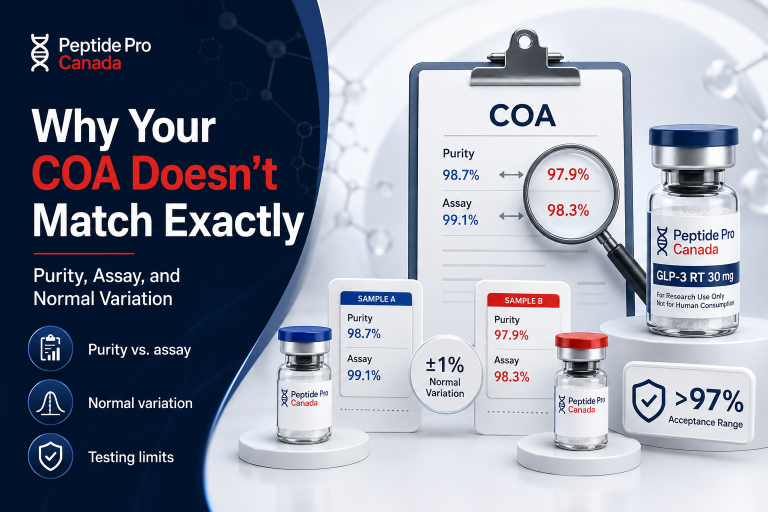
Quantity testing estimates how much peptide is present in the tested vial or sample. This is different from chromatographic purity.
A sample may report high chromatographic purity while containing a quantity that differs from the labelled amount. Both measurements can therefore matter when evaluating a batch.
Assay or Net Peptide Content
Assay-related measurements may account for factors that chromatographic purity alone does not describe. Terminology and calculation methods can differ between laboratories, so researchers should review the report’s method and definitions.
Read our article about why COA results vary and the difference between purity and assay for more information.
Heavy Metals
Heavy-metal analysis may report elements such as lead, arsenic, cadmium, or mercury. Results should identify the method, units, reporting limits, and tested sample.
A purity result does not substitute for heavy-metal testing.
Endotoxin Testing
Endotoxin testing evaluates bacterial endotoxins under the method and conditions stated on the report. It is a separate test and cannot be inferred from HPLC purity, identity, or visual appearance.
Sterility Testing
Sterility testing evaluates whether viable contaminating microorganisms are detected under defined test conditions. A report should identify the method, sample, test period, and result.
Sterility cannot be established from chromatographic purity, mass spectrometry, vial appearance, or a general claim that a product was manufactured under clean conditions.
What a COA Does Not Prove
Even a detailed COA has limits. A COA does not, by itself:
- Authorize a product for sale as a health product
- Constitute Health Canada approval
- Establish suitability for human or veterinary use
- Prove that every vial in a batch is identical
- Confirm tests that are not listed on the report
- Guarantee how a product was stored after testing
- Replace a laboratory’s own risk assessment
- Establish clinical safety or effectiveness
Health Canada authorization is a separate regulatory process. Health Canada explains that companies must submit appropriate evidence before a health product can be authorized for sale. Review Health Canada’s overview of how health products are regulated.
How to Evaluate a Peptide COA
Researchers should evaluate both the analytical results and the report itself.
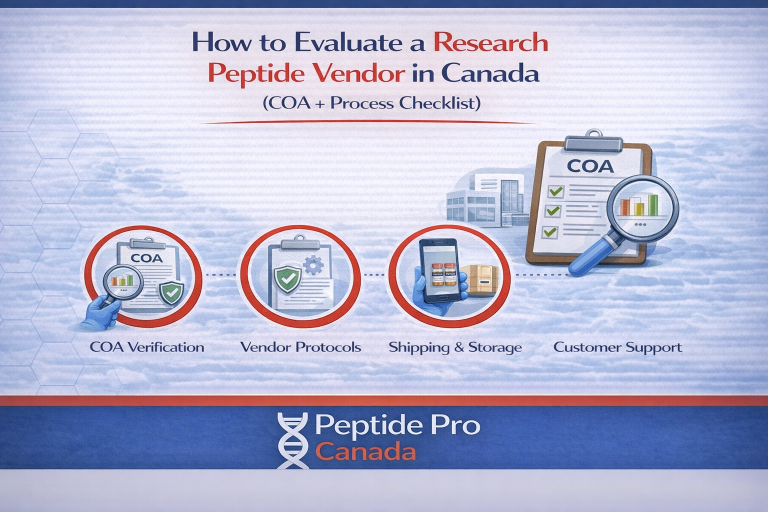
1. Match the Batch Number
Compare the lot or batch number on the vial with the batch number stated on the report. If they do not match, the report should not be presented as batch-specific documentation for that vial.
2. Confirm the Tested Material
Check the product name, expected molecular information, labelled quantity, and sample description. Watch for copied reports, incorrect strengths, or reports associated with another product.
3. Identify the Laboratory
The report should clearly identify the testing laboratory and provide enough information to verify its origin. Independent laboratory testing can reduce reliance on unverified internal claims, but independence alone does not guarantee that every method or result is suitable for a particular research purpose.
4. Review the Methods
Determine which analytical methods were used and what each method can establish. Do not interpret an HPLC purity result as proof of identity, quantity, sterility, endotoxin status, or heavy-metal content.
5. Check Dates and Report Numbers
Review the sample-receipt date, testing date, report date, and unique report identifier. Missing dates or identifiers can make verification and traceability more difficult.
6. Examine Units and Reporting Limits
Analytical results should use appropriate units. Values such as milligrams, percentages, parts per million, or endotoxin units describe different measurements and should not be treated as interchangeable.
7. Verify the Report
Where possible, use the laboratory’s verification system, QR code, report portal, or direct contact information. Verification helps determine whether the displayed report corresponds to an authentic laboratory record.
Why Multiple Testing Methods Matter
No single analytical test answers every quality question. A broader testing program may combine complementary methods addressing:
- Identity
- Chromatographic purity
- Peptide quantity or mass
- Assay or content
- Heavy metals
- Endotoxins
- Sterility
- Variation between sampled vials
The absence of a particular test should not be hidden or inferred from unrelated results. Documentation should describe the testing actually completed.
Independent and Batch-Specific Testing
PeptidePro Canada uses independent laboratory reports to document monitored research-product batches. Available testing may vary by product and batch, so researchers should review the actual reports associated with the inventory being considered.
Do not assume that every historical batch includes the same testing panel. The applicable product page and report should be reviewed directly.
COAs and Research Integrity
Reliable research depends on knowing what material was used. When batch identity, reported quantity, purity, and handling history are poorly documented, unexpected results become harder to investigate or reproduce.
A COA contributes to research integrity when it is:
- Authentic and verifiable
- Specific to the relevant batch
- Clear about the methods used
- Complete enough for the intended evaluation
- Stored with the laboratory’s project records
- Interpreted within its stated limitations
Frequently Asked Questions
Does a COA mean a peptide is approved by Health Canada?
No. A Certificate of Analysis reports analytical findings. It is not a Drug Identification Number, market authorization, product licence, or Health Canada approval.
Does a high purity percentage mean the vial contains the correct amount?
Not necessarily. Chromatographic purity and peptide quantity are different measurements. Review both when they are available.
Does HPLC purity prove sterility?
No. Sterility requires separate microbiological testing under defined conditions.
Can one COA represent every future batch?
No. A report should be connected to the specific batch tested. New batches require their own traceable documentation.
Is a supplier-generated COA the same as independent testing?
No. A supplier-generated document and a report produced by an independent laboratory have different levels of separation from the seller. Researchers should review the source and verification information.
Where can I learn how to read individual results?
Read our detailed guide on how to read a peptide Certificate of Analysis.
Final COA Checklist
Before relying on a COA, confirm:
- The product and batch numbers match.
- The testing laboratory is identified.
- The report has a unique identifier and date.
- The methods used are stated.
- The units and reporting limits are understandable.
- The report can be independently verified where possible.
- The testing panel addresses the characteristics relevant to the research.
- The report is not being treated as Health Canada authorization.
Properly interpreted peptide Certificates of Analysis support batch traceability and informed laboratory evaluation. Their value comes from accurate testing, clear methods, authentic reporting, and an honest understanding of their limitations.