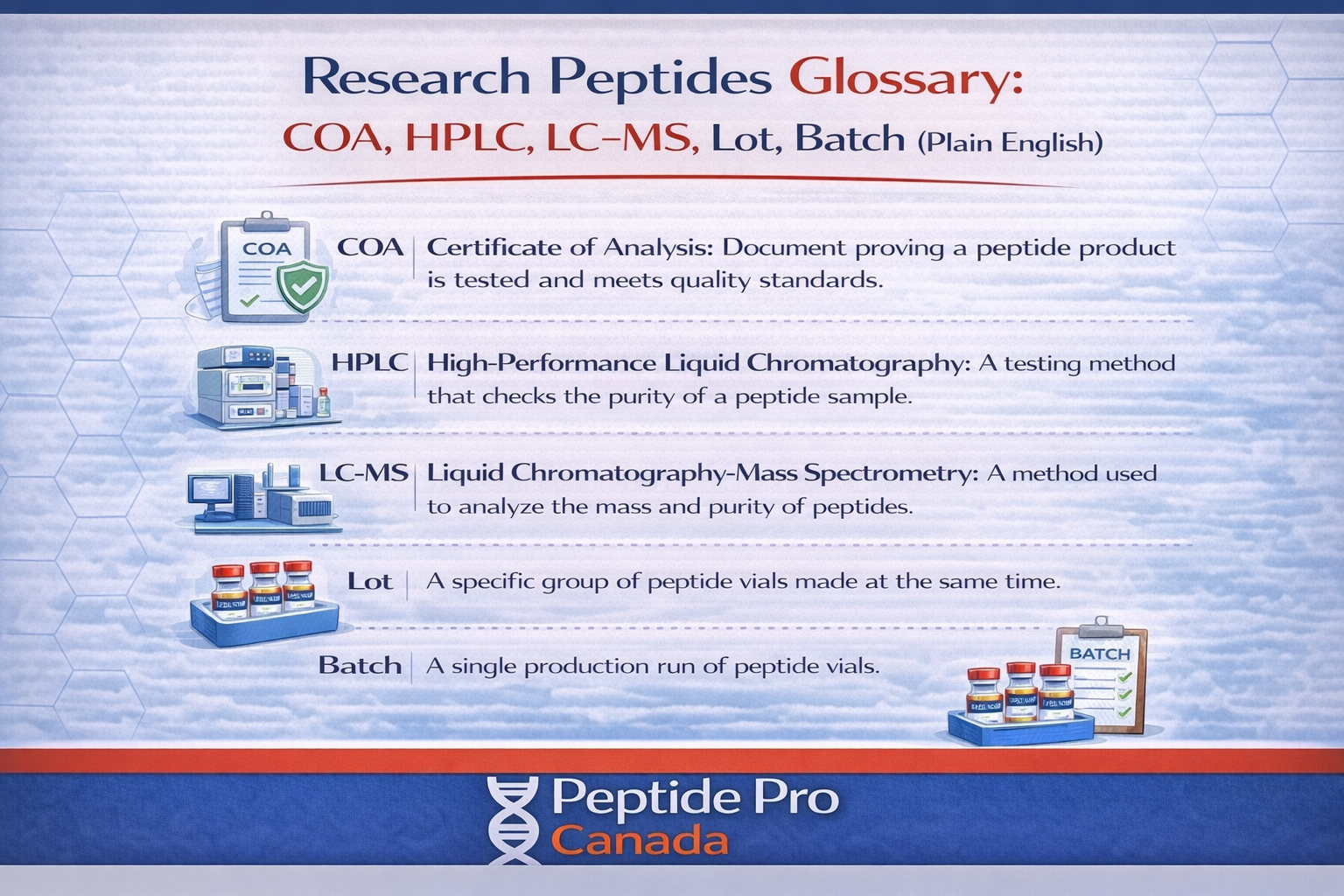
Research Peptides Glossary: COA, HPLC, LC-MS, Lot, Batch (Plain English)
This research peptides glossary explains common terms found on product pages, Certificates of Analysis, and independent laboratory reports. Understanding these terms helps researchers interpret documentation without treating unrelated measurements as interchangeable.
A laboratory result must be interpreted according to the tested sample, analytical method, units, specifications, and limitations stated on the report.
This glossary provides general laboratory information only. It does not provide medical, clinical, or personal-use guidance.
Research Peptides Glossary: Quick Reference
- COA: A document reporting specified analytical results for a sample or batch.
- HPLC: A chromatography technique commonly used to separate components and report relative chromatographic purity.
- LC-MS: Liquid chromatography combined with mass spectrometry.
- Identity: Evidence that a tested material is consistent with the expected compound.
- Purity: A measurement describing the relative amount of detected target material under a stated method.
- Assay: A quantitative measurement of the target compound using a defined method and reference.
- Lot or batch: An identifier connecting a material to its production and testing records.
- Specification: A predefined requirement or acceptance criterion.
Certificate of Analysis (COA)
A Certificate of Analysis is a document reporting analytical findings for a particular sample, lot, or batch. It may be issued by a manufacturer, supplier, or independent testing laboratory.
A useful COA commonly identifies:
- The tested material
- The sample, lot, or batch number
- The testing laboratory
- The analytical methods used
- The measured results and units
- The report or testing date
- A unique report identifier
- Applicable specifications or reporting limits
A COA is not automatically proof of Health Canada authorization, clinical safety, sterility, or suitability for human use. It reports only the analyses actually performed.
Learn more in our guide to reading a peptide Certificate of Analysis.
Lot and Batch
A lot or batch identifies material connected to a defined production or processing history. The terms are sometimes used interchangeably, although an organization may define them differently within its own quality system.
The vial’s batch number should match the batch number on the corresponding laboratory report. A report from another batch should not be presented as batch-specific evidence for current inventory.
Sample
A sample is the material actually submitted for analysis. A laboratory report directly describes the tested sample—not automatically every vial manufactured or sold under a related batch number.
Researchers should consider:
- Who selected the sample
- How it was packaged and transported
- Whether the laboratory received a sealed vial
- How many vials were tested
- Whether the sample number matches the report
HPLC
HPLC stands for high-performance liquid chromatography. It is a separation technique in which sample components move through a chromatographic system and are detected under specified conditions.
Peptide reports commonly use HPLC to estimate relative chromatographic purity. The result may be calculated from the areas of detected peaks, but its interpretation depends on the method, detector, integration settings, and sample preparation.
An HPLC purity percentage does not automatically establish:
- Molecular identity
- Total peptide quantity
- Sterility
- Endotoxin level
- Heavy-metal content
- Clinical safety
Review the IUPAC definition of liquid chromatography and HPLC for authoritative terminology.
Chromatogram
A chromatogram is the visual output of a chromatographic analysis. It generally displays detector response against time or another separation variable.
Peaks may correspond to detected components, but a peak does not identify itself. Identification requires the appropriate method, standards, or supporting analysis.
Peak Area
Peak area is the integrated detector response associated with a chromatographic peak. Relative peak-area percentages are often used in chromatographic purity calculations.
Peak-area percentage should not automatically be interpreted as percentage by total vial weight or total peptide quantity.
Retention Time
Retention time is the time required for a detected component to pass through the chromatographic system under the method’s conditions.
A matching retention time may support identification, but retention time alone is generally weaker than confirmation using additional evidence or orthogonal methods.
Mass Spectrometry (MS)
Mass spectrometry analyzes ions according to their mass-to-charge ratios. It can provide evidence that a tested compound is consistent with an expected molecular mass or fragmentation pattern.
MS can support identity, but the exact information produced depends on the instrument, ionization method, calibration, sample, and analysis.
The United States National Institute of Standards and Technology provides a general overview of mass spectrometry and combined chromatographic methods.
LC-MS
LC-MS stands for liquid chromatography–mass spectrometry. Liquid chromatography separates components before detection by a mass spectrometer.
LC-MS may provide both separation information and mass-based evidence about detected compounds. It is commonly used to support identity and characterize complex samples.
Review the IUPAC definition of liquid chromatography–mass spectrometry.
Expected Molecular Mass
Expected molecular mass is the calculated mass associated with the intended molecular structure. A laboratory may compare the expected value with an observed result.
Interpretation can be affected by charge state, adducts, salts, counterions, isotope patterns, fragments, and the reporting convention used by the laboratory.
Identity
Identity testing evaluates whether the tested material is consistent with the compound stated on the label. The appropriate method depends on the material and required level of certainty.
Identity is separate from:
- Purity
- Quantity
- Sterility
- Endotoxin testing
- Heavy-metal testing
A material may report high chromatographic purity while still requiring separate identity confirmation.
Purity
Purity describes the proportion of target material relative to other detected components under a stated analytical method.
On peptide COAs, “purity” often refers to relative chromatographic purity. Researchers should check:
- The analytical method
- The detector used
- The calculation approach
- Whether solvents or other components are excluded
- The stated reporting limits
Assay
An assay is a quantitative procedure used to measure the amount or concentration of a target compound relative to a reference, standard, or defined method.
Assay and chromatographic purity are not necessarily the same measurement. Results should not be expected to match unless the methods and calculations support that comparison.
IUPAC describes an HPLC assay as an assay in which response is determined after chromatographic separation with concurrent detection.
Peptide Quantity or Mass
Peptide quantity or mass estimates how much peptide is present in the tested vial or sample. This may be reported in milligrams or another appropriate unit.
Quantity testing is distinct from chromatographic purity. A vial can report high relative purity while containing more or less peptide than its labelled quantity.
Net Peptide Content
Net peptide content is a laboratory-specific term that may account for the measured peptide component separately from water, counterions, salts, or other non-peptide contributions.
Researchers should review the laboratory’s definition and method rather than assuming every laboratory calculates net peptide content identically.
Impurity
An impurity is a non-target component detected or measured under the stated method. Reports may describe:
- Specified impurities
- Unspecified impurities
- Total impurities
- Individual detected peaks
- Degradation-related components
An unidentified peak does not automatically reveal its chemical identity or risk.
Specification
A specification is a predefined requirement against which a result is evaluated. Examples might include an identity requirement, minimum purity, quantity range, or contaminant limit.
A specification should identify:
- The characteristic being evaluated
- The analytical method
- The units
- The acceptance criterion
Acceptance Criterion
An acceptance criterion defines the result required for a sample to conform to a specification. Examples include a minimum, maximum, range, absence requirement, or other defined outcome.
A “Pass” result is more informative when the underlying criterion and measured result are available.
Limit of Detection (LOD)
The limit of detection is the lowest level at which an analyte can be detected under the method’s conditions, although it may not be reliably quantified at that level.
Limit of Quantification (LOQ)
The limit of quantification is the lowest level at which an analyte can be quantitatively measured with the method’s stated performance.
LOD and LOQ should not be treated as interchangeable.
Reporting Limit
A reporting limit is the threshold used by a laboratory for reporting a result. It may depend on the method, instrument, sample preparation, and laboratory procedure.
A result reported as “less than” a limit does not necessarily mean the analyte is completely absent. It means the result was below the applicable reporting threshold.
Heavy Metals
Heavy-metal testing evaluates specified elemental contaminants, potentially including lead, arsenic, cadmium, or mercury.
The report should identify:
- The elements tested
- The analytical method
- The result and units
- The reporting limit
- Any applicable acceptance criteria
Heavy-metal status cannot be inferred from HPLC purity.
Endotoxins
Endotoxins are components associated with certain bacteria. Endotoxin analysis is a separate test with its own method, units, limits, and sample requirements.
A sterility result and an endotoxin result answer different questions. Neither should be inferred from the other.
Sterility Testing
Sterility testing evaluates whether viable contaminating microorganisms are detected under defined test conditions.
A sterility report should identify the tested sample, method, incubation or observation period, and result. Sterility cannot be determined from appearance, purity, mass spectrometry, or a general manufacturing claim.
Rapid Sterility and Compendial-Period Testing
Rapid methods may produce results sooner than traditional growth-based methods. A longer observation period may provide a separate or confirmatory assessment.
Researchers should review the actual method and reporting period rather than treating all sterility tests as identical.
Conformity Testing
Conformity testing evaluates whether multiple sampled vials produce results that fall within defined criteria. It can provide information about variation among the tested vials.
Testing several vials provides broader sample information than testing one vial, but it does not prove that every vial in the batch is identical.
Independent Laboratory
An independent laboratory is organizationally separate from the seller or manufacturer whose material it tests. Independent testing can reduce reliance on unverified internal claims.
Researchers should still evaluate the laboratory, methods, sample selection, report authenticity, and relevance of the tests performed.
Chain of Custody
Chain of custody documents the possession, transfer, and handling of a sample from collection or submission through analysis and reporting.
Detailed chain-of-custody information can help establish who selected the sample, how it was identified, and whether its handling was documented.
Report Verification
Report verification confirms that a displayed COA corresponds to an authentic laboratory record. Verification may be available through:
- A laboratory report portal
- A QR code
- A unique verification link
- A report number
- Direct confirmation from the laboratory
Retest Date and Expiry Date
A retest date indicates when a material may require reevaluation to confirm that it continues to meet defined specifications. An expiry date indicates the end of a defined period under stated conditions.
The meaning and supporting evidence can vary, so researchers should review the applicable documentation and storage history.
Research Use Only (RUO)
Research Use Only indicates that a material is intended for legitimate laboratory or analytical work rather than human or veterinary use.
Health Canada states that research-use labelling does not automatically make an unauthorized product legal or exempt it from regulatory requirements. Read our guide explaining what Research Use Only means.
Frequently Asked Questions
What is the most important information on a COA?
The batch match, tested material, laboratory, methods, results, units, report date, and verification information are all important. No single field replaces the others.
Is HPLC purity the same as peptide quantity?
No. Relative chromatographic purity and peptide quantity are separate measurements.
Does LC-MS prove sterility?
No. LC-MS may support chemical identity or characterization. Sterility requires separate microbiological testing.
Does a COA mean Health Canada approved the product?
No. A COA reports analytical results. It is not a market authorization, Drug Identification Number, licence, or Health Canada approval.
Why can two laboratories report different results?
Differences may result from sampling, sample preparation, calibration, reference standards, instruments, methods, integration settings, calculations, or laboratory measurement uncertainty.
Read more about why COA results can vary.
Final Documentation Checklist
When reviewing a report, confirm:
- The product and batch numbers match.
- The tested sample is clearly identified.
- The testing laboratory is named.
- The methods and units are stated.
- The results are interpreted against relevant specifications.
- Unreported tests are not being implied.
- The report can be verified where possible.
- The COA is not being treated as Health Canada authorization.
Use this research peptides glossary when reviewing product documentation, but always interpret each report according to its own methods, results, and stated limitations.