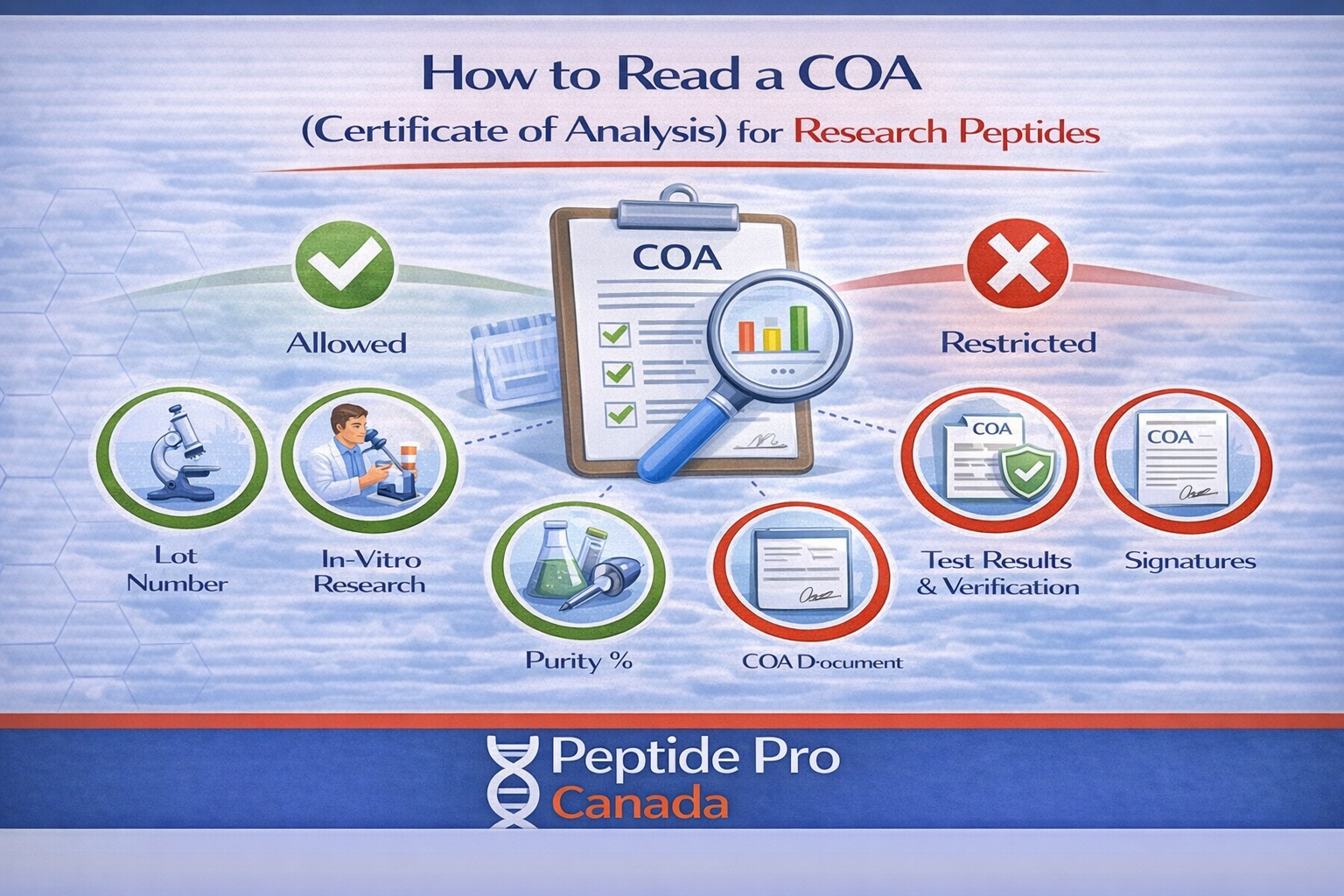
How to Read a COA (Certificate of Analysis) for Research Peptides
If you’re buying or selling research peptides Canada, a COA (Certificate of Analysis) is one of the few documents that can actually back up what a batch is supposed to be. This post shows you how to read a peptide COA like a skeptical buyer, without turning it into a “trust me bro” situation.
This is general information, not legal advice.
Quick answer
- A COA is a batch-specific document listing test results and specs for that lot.
- The COA matters most when it includes batch/lot, test methods, results, and pass/fail vs spec.
- A COA is not a magic stamp. You still need to check for missing info and red flags.
What a COA is
A Certificate of Analysis (COA) is a document tied to a specific batch/lot that reports test results against defined specifications. Health Canada’s GMP guidance for active pharmaceutical ingredients describes a CoA as a document that includes details like the lab performing the tests and the name/specifications/results. ISO/IEC 17025 is a lab competence standard often used as a quality signal for testing labs.
How to read a peptide COA (step-by-step)
1) Confirm the product name matches exactly
- Compound name should match what’s being sold (spelling matters).
- If salts/forms apply (acetate, base, etc.), it should be consistent.
2) Check batch/lot number and report date
- You want a clear lot/batch identifier.
- The report date should make sense for the batch timeline.
- If every COA looks identical across “different batches,” that’s a red flag.
3) Look for the lab name and contact details
- COAs should identify who performed the testing.
- If the “lab” is vague or missing, treat the COA as weak evidence.
4) Identify what was actually tested
Good COAs don’t just show numbers. They show what test produced the number. Common peptide COA line items include:
- Identity (often via MS/LC-MS or similar)
- Purity (often via HPLC)
- Assay / content (how much target compound is present)
- Impurities (specified/unspecified/total, if reported)
5) Purity vs assay: don’t mix these up
- Purity is usually reported as a chromatographic purity number (example: HPLC %).
- Assay/content is how much target compound is present relative to a spec or claim.
Some COAs only show one of these. That doesn’t automatically mean “bad,” but it means you have less to work with.
6) Read the “spec” column, not just the “result”
- A real COA usually shows a specification range and the result.
- “Pass” without specs is weaker than “Result: 98.2% (Spec: ≥98.0%).”
7) Confirm units and method notes
- Watch for missing units (%, mg/mL, ppm, etc.).
- Method notes matter (HPLC conditions, detector, reference standard notes).
COA red flags (don’t ignore these)
- No lot/batch number.
- No lab name or lab details.
- No test methods listed (just “Pass”).
- Perfect-looking results across every batch with no variation.
- Typos, mismatched product names, or copy-paste formatting errors.
- No specs, no acceptance criteria, no context.
What a COA can’t tell you
- It can’t replace proper chain-of-custody for every step between source and end buyer.
- It doesn’t prove how a product was stored or handled after testing.
- It doesn’t prove “real-world performance.” A COA is a documentation tool, not a promise.
FAQ
Is an ISO/IEC 17025 lab always required?
No. It’s a quality signal because it relates to lab competence and valid results, but not every COA you see will come from an accredited lab. If a lab claims ISO/IEC 17025, you can verify that claim through the lab’s accreditation listing.
Is HPLC purity the only number that matters?
No. Purity is useful, but identity and how the result compares to specs also matter. A COA with weak method detail is still weak, even with a high purity number.
Should every COA show impurities?
Not always, but impurity reporting and clear acceptance criteria are stronger than “pass” without detail.
Safe call to action
For full quality details, refer to the COA images on each product page (typically the second and third images), and match the lot/batch on the COA to the lot/batch listed for that product.