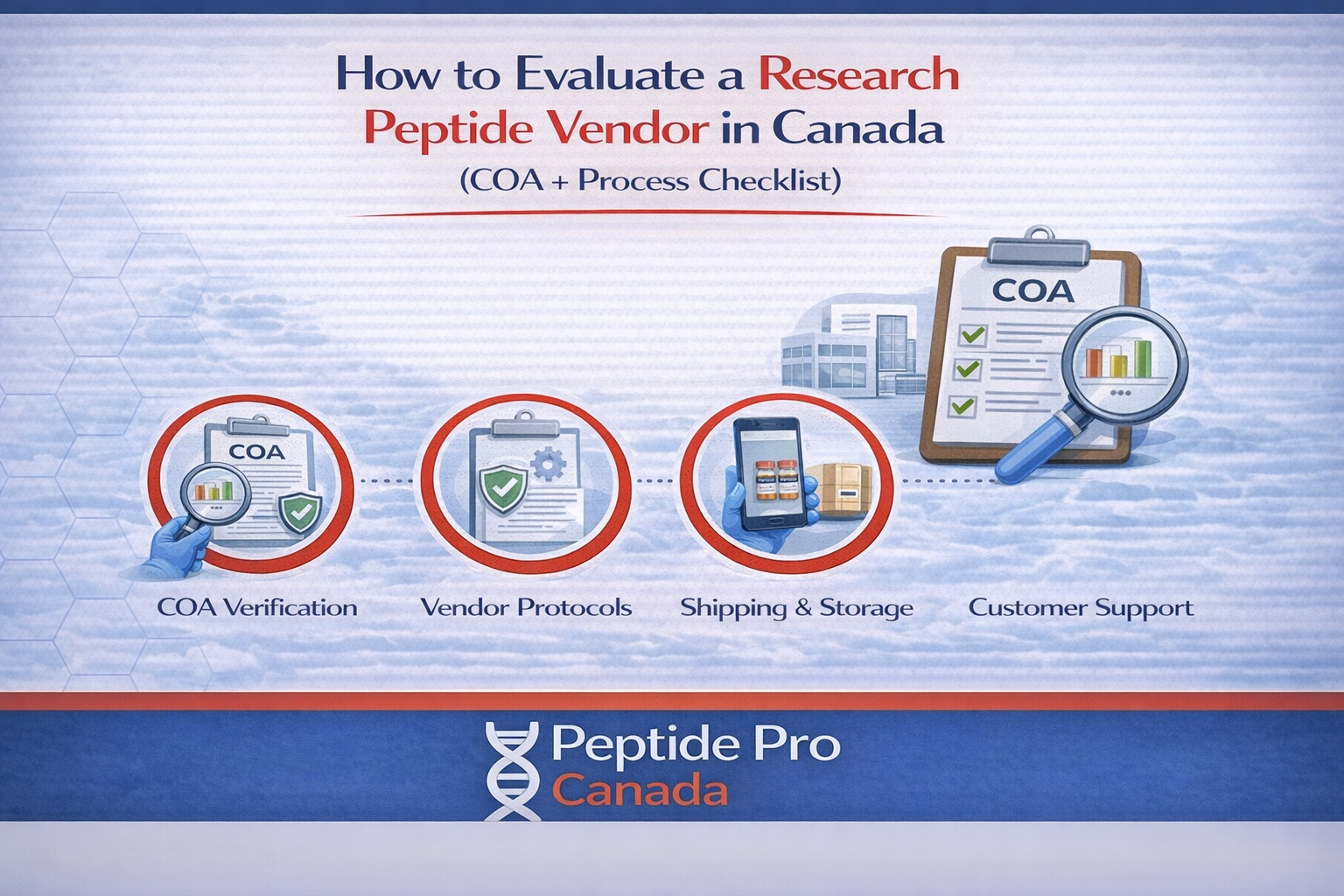
How to Evaluate a Research Peptide Vendor in Canada (COA + Process Checklist)
Evaluating a research peptide vendor Canada laboratories may consider requires more than reading purity claims or customer ratings. Researchers should examine batch traceability, analytical methods, report verification, sample selection, storage information, business policies, and regulatory positioning.
No checklist can guarantee that a supplier or material is suitable for a particular project. Purchasers remain responsible for their own legal, regulatory, safety, and institutional requirements.
This article provides general laboratory and purchasing information only. It does not constitute legal, medical, or regulatory advice.
Research Peptide Vendor Canada Evaluation Checklist
Before placing an order, determine whether the supplier provides enough verifiable information to support an informed laboratory purchasing decision.
The most important areas to review are:
- Business identity and contact information
- Batch-specific documentation
- Testing methods and laboratory verification
- Sample selection and batch traceability
- Storage and handling information
- Research-use restrictions
- Shipping, returns, and support policies
- Privacy and payment practices
1. Confirm the Business Is Identifiable
A research supplier should provide clear information about who operates the website and how support can be reached.
Look for:
- A consistent business or brand name
- A working support email address or contact form
- Published shipping and policy pages
- A privacy policy and terms of service
- Consistent contact information across the website
- A secure HTTPS website connection
A polished website does not prove product quality, but missing business information can make order issues and documentation questions harder to resolve.
2. Look for Batch-Specific COAs
A Certificate of Analysis should connect to the specific product batch being evaluated. Generic reports or reports from unrelated inventory provide limited evidence about the current material.
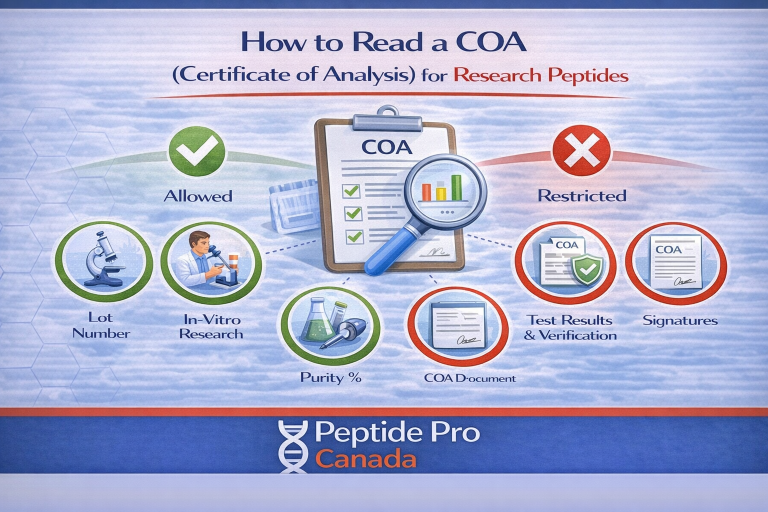
Check whether the COA includes:
- The product or peptide name
- The lot or batch number
- The sample identifier
- The testing laboratory
- The analytical methods
- The measured results and units
- The report date
- A unique report or verification number
The batch number on the report should match the batch number associated with the vial or product documentation.
3. Understand What Was Actually Tested
Not every COA includes the same analytical panel. A report may include one or more of the following:
- Identity
- Chromatographic purity
- Peptide quantity or mass
- Assay or net peptide content
- Heavy metals
- Endotoxins
- Sterility
- Testing across multiple sampled vials
Do not assume that a purity result establishes quantity, sterility, endotoxin status, or heavy-metal content. Each characteristic requires an appropriate test.
Use our research peptides glossary to understand common report terminology.
4. Verify the Testing Laboratory
A report should clearly identify the laboratory that performed the work. When possible, verify the report through:
- The laboratory’s report portal
- A QR code
- A unique verification link
- A report number
- Direct confirmation from the laboratory
A laboratory logo copied onto a document is not the same as independent verification. Researchers should determine whether the named laboratory recognizes the report.
5. Ask How Samples Are Selected
Independent testing and independent sample selection are related but different issues.
A third-party laboratory may test the sample it receives, but the report does not necessarily explain:
- Who selected the vial
- How many vials were available
- Whether the sample was randomly selected
- How it was transported
- Whether more than one vial was tested
- Whether retained samples exist
Testing one vial provides evidence about that tested vial. Multiple-vial testing may provide more information about variation, but it does not prove every vial is identical.
6. Evaluate Report Consistency
Look across several products and batches rather than evaluating only one unusually strong report.
Check whether:
- New batches receive new reports
- Report dates change appropriately
- Batch numbers are consistent across labels and documents
- Reports identify the correct product and strength
- Results are presented with methods and units
- Older documentation is clearly distinguished from current inventory
Several unrelated products using the same batch number, report, chromatogram, or test result would require clarification.
7. Understand COA Limitations
A COA can support laboratory evaluation, but it does not automatically:
- Constitute Health Canada authorization
- Establish suitability for human or veterinary use
- Confirm tests not listed on the report
- Guarantee the condition of every vial
- Prove how inventory was stored after testing
- Replace the purchaser’s own risk assessment
Read our detailed guide explaining how to read a peptide Certificate of Analysis.
8. Review Storage and Handling Information
A supplier should avoid applying one universal storage statement to every compound. Material-specific information should be provided where available.
Researchers should be able to determine:
- The product’s physical form
- The documented storage condition
- Whether light or moisture protection is relevant
- How damaged packaging should be reported
- How batch documentation remains connected to inventory
Claims such as “stable under all shipping conditions” or “never requires temperature control” should be supported by appropriate evidence rather than marketing language.
9. Review Research-Use Positioning
A laboratory supplier should clearly state that its research materials are not intended for human or veterinary use.
Warning signs include:
- Dosing or cycle information
- Mixing or reconstitution ratios
- Injection or administration instructions
- Weight-loss or body-composition claims
- Healing, recovery, or anti-aging claims
- Personal-use recommendations
- Testimonials describing physiological outcomes
A “Research Use Only” disclaimer does not correct a website that otherwise promotes products for human use.
Health Canada has specifically warned that research-use labelling does not automatically make unauthorized products legal or exempt them from regulatory requirements. Review the official Health Canada warning about unauthorized peptide products.
10. Examine Shipping and Damage Policies
Shipping problems can happen even when the product and documentation are appropriate. A supplier should clearly explain:
- Order-processing times
- Shipping carriers
- Tracking procedures
- Address responsibilities
- Steps for delayed shipments
- What to do when a package arrives damaged
- Photograph and packaging requirements
- Return, replacement, and refund conditions
Review our shipping and returns information for an example of a documented process.
11. Assess Customer Support
Useful support should be able to answer legitimate order, shipping, batch, and documentation questions without providing human-use guidance.
Before ordering, check whether:
- The support channel is easy to locate
- The expected information is explained
- Policies identify the review process
- Batch-documentation questions can be submitted
- Human-use questions are clearly declined
Read what to include when you contact customer support.
12. Review Payment and Privacy Practices
A supplier should provide a secure website and explain how customer information is collected and used.
Purchasers should never be asked to send:
- Online banking passwords
- Full payment-card numbers by email or messaging
- Card security codes
- Unnecessary identity documents
- Unredacted financial statements
Review the privacy policy, payment instructions, and checkout security before submitting an order.
Research Peptide Vendor Warning Signs
- No batch-specific reports
- COAs with no laboratory or report number
- Reports that cannot be verified
- No test methods or units
- Purity presented as proof of every quality characteristic
- One report reused across unrelated batches
- Human-use claims or administration guidance
- Missing shipping, privacy, or refund policies
- No identifiable support channel
- Promises that exceed the evidence shown
- Pressure to communicate only through disappearing messages
- Requests for unnecessary financial or identity information
Questions to Ask Before Ordering
- Which batch is currently available?
- Does the displayed COA match that batch?
- Which laboratory performed each test?
- Can the report be independently verified?
- What analytical methods were used?
- Was peptide quantity tested separately from purity?
- Were sterility, endotoxins, or heavy metals tested?
- How many vials were sampled?
- What storage information is available?
- What happens if the package arrives damaged?
Frequently Asked Questions
Is one COA enough to evaluate a vendor?
No. Review documentation across multiple products and batches, along with traceability, policies, support, and regulatory positioning.
Does independent testing guarantee quality?
No. It reduces reliance on internal claims, but researchers must still evaluate the sample, laboratory, methods, results, report authenticity, and relevance of the testing.
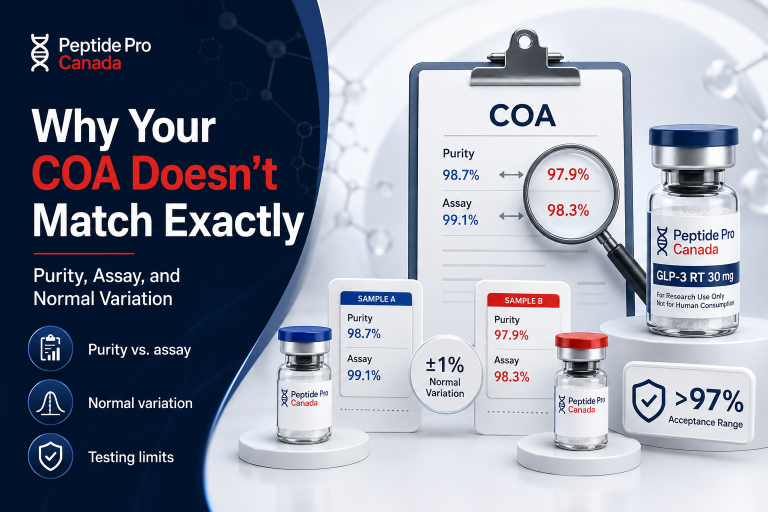
Does a high purity percentage mean the vial contains the correct quantity?
Not necessarily. Relative chromatographic purity and peptide quantity are different measurements.
Does a COA prove the product is legal?
No. A COA is an analytical report, not a licence, market authorization, or legal opinion.
Why do vendor policies matter?
Clear policies explain what happens when an order is delayed, damaged, missing an item, or connected to the wrong documentation.
Final Vendor Evaluation Checklist
Before selecting a research peptide vendor Canada laboratories may purchase from, confirm:
- The business and support channels are identifiable.
- Current batch-specific reports are available.
- The laboratory and reports can be verified.
- The testing methods and units are stated.
- COA limitations are represented honestly.
- Storage and batch traceability are documented.
- The website avoids human-use promotion.
- Shipping, damage, privacy, and refund policies are clear.
- The material and supplier meet the requirements of the intended research.
A professional website or high numerical purity result should never replace careful documentation review. Verifiable testing, traceability, honest limitations, and clear processes provide a stronger basis for laboratory purchasing decisions.