Why Your COA Doesn’t Match Exactly (Purity, Assay, and Normal Variation)
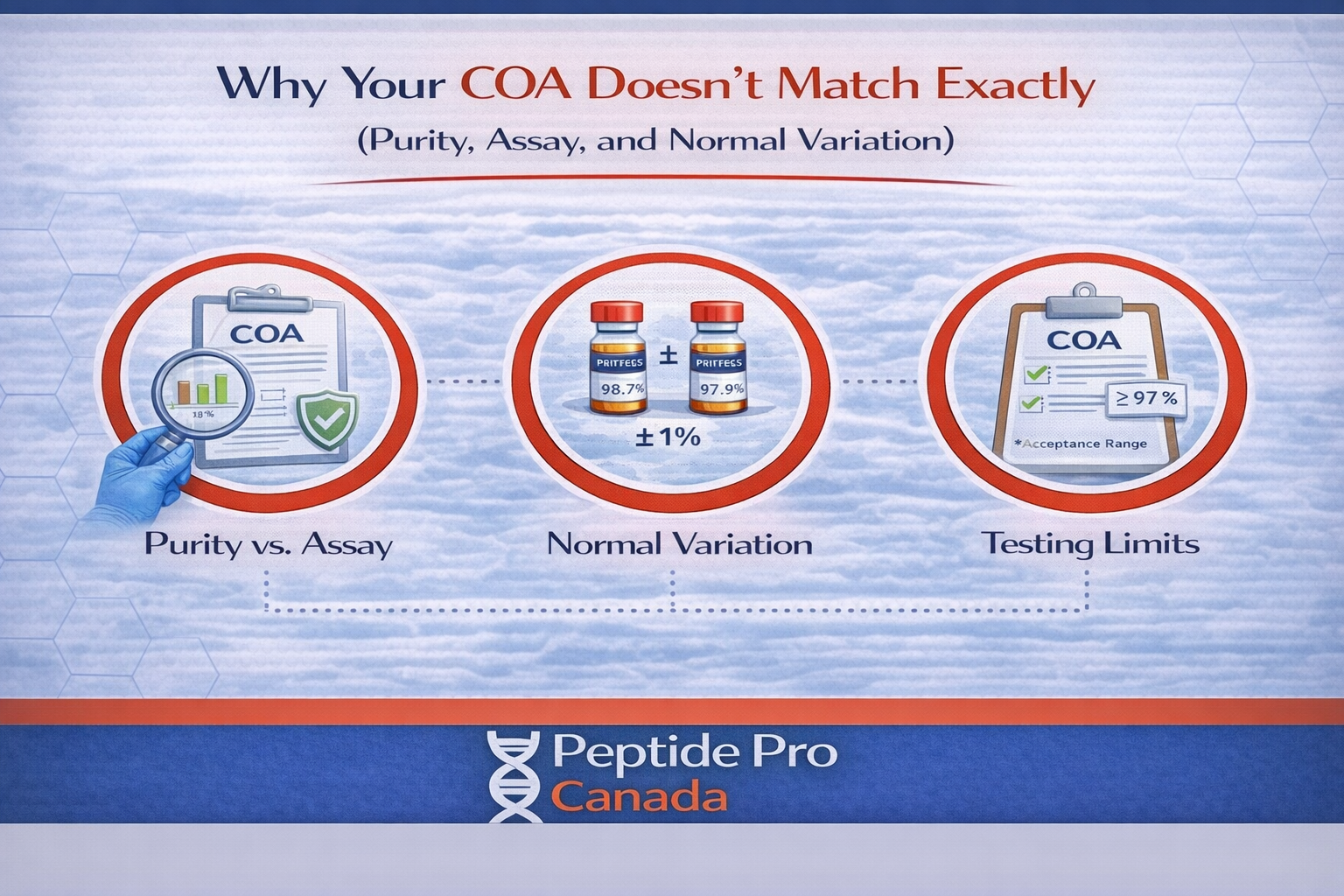
If you’re buying from a research peptides Canada vendor, you’ll sometimes see a COA number that isn’t what you “expected.” People fixate on one value and assume something is wrong. Most of the time, it’s a misunderstanding: purity vs assay, method differences, rounding, and normal batch variation.
This is general information, not legal advice.
Quick answer
- Purity and assay/content are not the same thing.
- Different labs and methods can give slightly different results.
- Batch variation and rounding are normal. What matters is the result vs the spec.
The most common confusion: purity vs assay
Two COAs can look “inconsistent” because people compare different measurements:
- Purity is often reported as a chromatographic purity percentage (commonly from HPLC).
- Assay/content relates to the amount of target compound present relative to a defined standard/spec.
So if one report shows purity and another shows assay, you are not comparing apples to apples.
Why results can vary between COAs
1) Different methods
A COA that lists “HPLC purity” is not the same as a report listing “assay” or “identity.” If the method changes, the number you see can change too.
2) Different labs and instruments
Different labs may use different columns, gradients, detectors, reference standards, or integration settings. That can shift results slightly, especially near a cutoff.
3) Rounding and reporting format
Some COAs round to one decimal. Others report two decimals. Some report “>99%.” Others report “99.12%.” That formatting difference can look bigger than it is.
4) Normal batch variation
Even when a process is consistent, batches vary. That’s why COAs use specifications and acceptance criteria.
What you should focus on instead
1) Does the COA show specs and pass/fail?
The strongest COAs show a specification (example: “≥98.0%”) and a result (example: “98.6%”). “Pass” with no spec is weaker.
2) Does the COA match the lot/batch?
Lot/batch matching is one of the best trust signals. If the COA has no lot/batch, it’s weak documentation.
3) Does the COA list the method?
If the COA doesn’t tell you what test produced the number, you can’t interpret it.
Red flags (this is when to worry)
- No lot/batch number.
- No lab name or no test methods listed.
- Only “Pass” with no spec or result.
- COAs that look identical across many “different” lots.
- Mismatch between product name and COA name.
FAQ
Should every peptide be 99%+?
No. A quality COA is about results vs specs and traceability, not chasing the highest number. Different products and methods can yield different purity ranges.
Is a lower number always bad?
Not automatically. First confirm what is being measured (purity vs assay) and compare it to the spec/acceptance criteria.
Can a vendor “cherry pick” COAs?
Some do. That’s why lot/batch matching and consistent COA publishing matters. A single “perfect” COA without traceability is weak evidence.
Safe call to action
If you’re reviewing documentation, start with our COA guide and compare the COA lot/batch to the product lot/batch where provided.