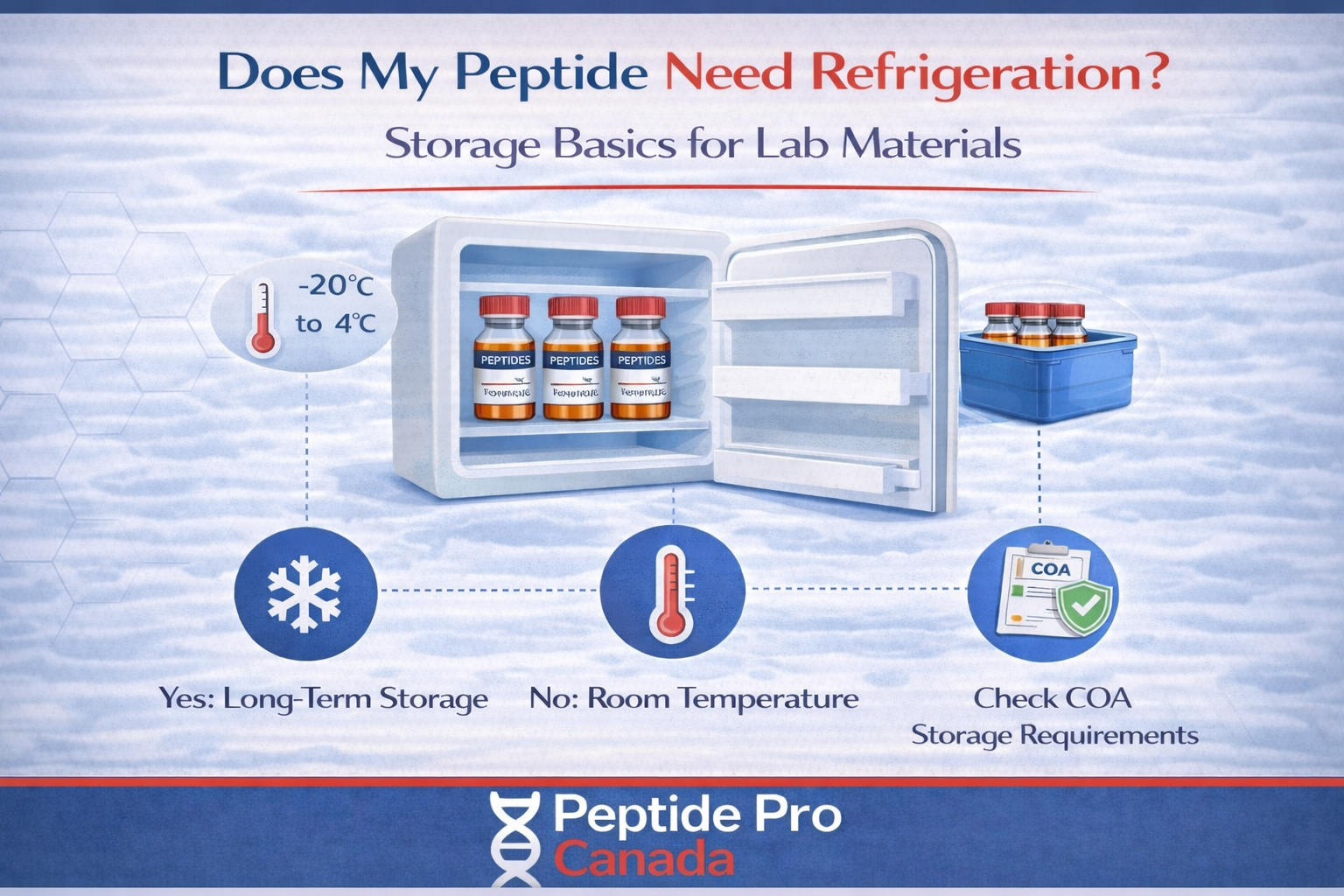
Does My Peptide Need Refrigeration? Storage Basics for Lab Materials
Peptide refrigeration may be appropriate for some laboratory materials, but there is no universal storage temperature for every peptide, formulation, or physical form. Researchers should follow material-specific documentation and approved laboratory procedures rather than assuming that every vial belongs in a refrigerator or freezer.
Storage decisions should consider the compound, formulation, packaging, intended storage period, moisture sensitivity, light sensitivity, and available stability information.
This article provides general laboratory information only. It does not provide medical, clinical, reconstitution, or personal-use guidance.
Does Every Peptide Need Refrigeration?
No. Different peptides can have different stability profiles. Storage requirements may also differ between a dry lyophilized material and a prepared laboratory solution.
Before selecting a storage condition, review:
- The product label
- Material-specific storage documentation
- The lot or batch number
- The physical form of the material
- The container and closure system
- Available technical or safety information
- The laboratory’s approved procedure
If adequate information is unavailable, consult the laboratory supervisor, safety officer, supplier, or another qualified professional before assigning storage conditions.
What Peptide Refrigeration Is Intended to Do
Controlled cold storage may slow some degradation processes. However, refrigeration does not prevent every possible change and does not correct prior exposure, contamination, unsuitable packaging, or improper handling.
Storage temperature is only one part of a complete storage system. Researchers should also consider:
- Moisture and humidity
- Light exposure
- Oxygen exposure where relevant
- Container integrity
- Temperature consistency
- Storage duration
- Inventory traceability
Lyophilized Material and Laboratory Solutions
Lyophilized Material
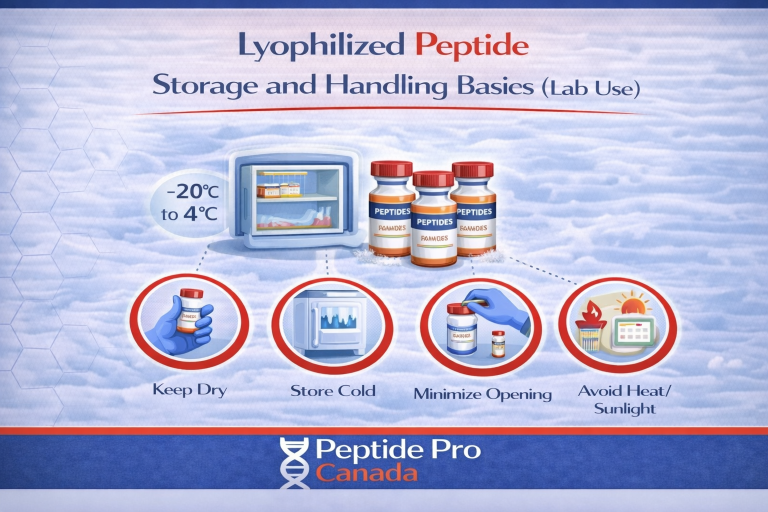
Lyophilization is a freeze-drying process that removes much of the water from a material. A lyophilized peptide may be more stable than the same material in solution under certain conditions, but it remains susceptible to moisture, heat, light, contamination, and packaging failure.
Freeze-dried material should not automatically be assumed stable at every temperature or for an unlimited period.
Prepared Laboratory Solutions
A peptide in a laboratory solution may have a different stability profile from the dry material. Stability can depend on the solvent system, concentration, container, light exposure, temperature, time, and other experimental conditions.
Researchers must use a validated or approved procedure appropriate to the particular laboratory application. General online advice should not replace material-specific stability information.
Why Moisture and Condensation Matter
Condensation can form when a cold container is exposed to warmer, humid air. If the container is opened under uncontrolled conditions, moisture may enter and affect a material intended to remain dry.
To reduce avoidable condensation risk:
- Plan the laboratory work before removing material from storage.
- Use a clean and controlled workspace.
- Avoid opening containers unnecessarily.
- Keep storage areas dry and appropriately maintained.
- Follow the laboratory’s procedure for moving materials between environments.
Do not improvise handling procedures when the material’s moisture sensitivity is unknown.
Why Repeated Temperature Cycling Matters
Repeated movement between cold and warm environments may introduce condensation and temperature stress. It can also make storage history more difficult to document.
Laboratories can reduce unnecessary cycling by:
- Assigning each material a fixed storage location
- Using labelled racks and storage boxes
- Maintaining an accurate inventory system
- Removing only the material required for scheduled work
- Recording relevant removal and return times
- Avoiding repeated opening of storage equipment
Refrigeration Versus Freezing
Freezing is not automatically better than refrigeration. The coldest available temperature is not necessarily the correct condition for a particular material.
Potential considerations include:
- The compound’s documented stability profile
- Whether freezing may affect the formulation or container
- The likelihood of repeated freeze-and-thaw events
- The reliability of the storage equipment
- Whether the laboratory can monitor and document the temperature
- The available response plan for equipment failure
Use the documented condition appropriate to the specific material rather than selecting storage based only on a general preference for colder temperatures.
Light Exposure
Some laboratory materials may be sensitive to ultraviolet or visible light. When light sensitivity is documented, use the protective container and storage conditions specified for the material.
If the sensitivity profile is unknown, avoid unnecessary exposure to direct sunlight and intense light sources. Do not remove protective packaging without a laboratory reason.
Storage Equipment and Temperature Monitoring
Laboratory cold-storage equipment should be suitable for its intended purpose and monitored according to institutional requirements.
A storage system may include:
- Calibrated temperature monitoring
- Minimum and maximum temperature records
- High- and low-temperature alarms
- Restricted access
- Routine equipment inspections
- Backup power or alternate storage
- A documented temperature-deviation procedure
Household appliances may experience larger temperature changes than purpose-designed laboratory equipment. The appropriate equipment depends on the material and the laboratory’s requirements.
Review Labels and Safety Documentation
Where applicable, review the product label, technical information, Safety Data Sheet, and laboratory procedures before storing or handling a material.
The Canadian Centre for Occupational Health and Safety explains that safety documentation communicates product hazards and recommended precautions. Review the CCOHS information about Safety Data Sheets for general Canadian workplace guidance.
Does a Warm Shipment Mean the Peptide Is Damaged?
No. The temperature of a package when it arrives does not, by itself, establish that the material has degraded.
The significance of a temperature exposure depends on:
- The specific material
- The physical form
- The packaging
- The temperature reached
- The duration of exposure
- Available stability information
If a shipment arrives wet, opened, visibly damaged, or under unusual conditions, photograph the package and contents before discarding anything. Review our shipping and returns information and contact support with the order number, tracking number, and photographs.
Warning Signs Requiring Review
Do not place a questionable vial into regular inventory without review. Warning signs include:
- A cracked or damaged vial
- A loose or compromised closure
- Moisture inside a vial expected to contain dry material
- An unreadable label
- A missing or mismatched batch number
- An unexpected change in appearance
- An undocumented temperature deviation
Appearance alone cannot establish identity, purity, quantity, or stability.
Storage Records and Batch Traceability
Maintain records connecting each vial to its documentation and storage history. Record:
- Product name
- Lot or batch number
- Date received
- Condition on arrival
- Assigned storage location
- Documented temperature requirement
- Relevant handling events
- Temperature alarms or deviations
- Corrective actions
Available batch reports can be reviewed through our Certificates of Analysis page.
Frequently Asked Questions
Should every research peptide be refrigerated?
No. Storage requirements vary by compound, formulation, physical form, packaging, and available stability information.
Is freezing always better?
No. The coldest possible condition is not automatically the correct one. Follow the documented requirements for the specific material.
Can I determine stability from appearance?
No. Appearance cannot confirm identity, purity, quantity, or chemical stability.
Why is condensation a concern?
Condensation may introduce moisture to a material intended to remain dry and can complicate controlled laboratory handling.
What should happen after a temperature alarm?
Follow the laboratory’s deviation procedure. Document the temperature, duration, affected inventory, equipment status, and corrective action. Isolate material when required until its status is evaluated.
Where can I learn more about storage?
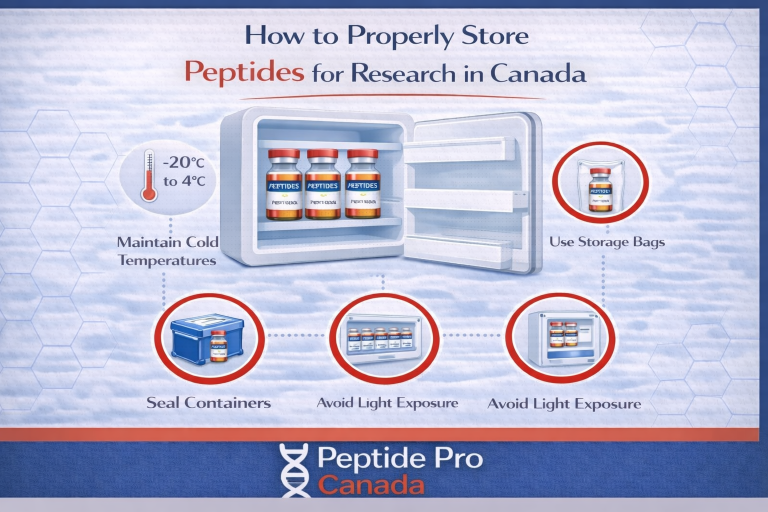
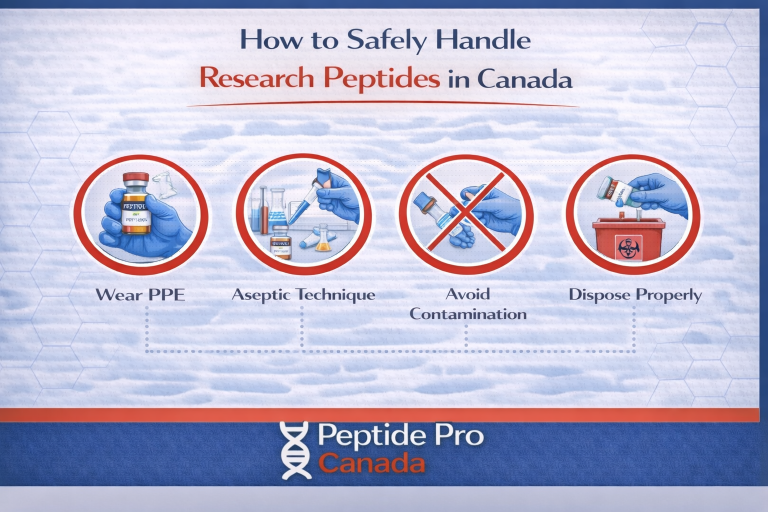
Read our guides to storing peptides for research and lyophilized peptide storage and handling.
Final Refrigeration Checklist
Before selecting peptide refrigeration or another storage condition, confirm:
- The material and batch are correctly identified.
- The physical form is known.
- The documented storage requirements have been reviewed.
- The storage equipment is appropriate and monitored.
- Moisture and light exposure are controlled.
- Temperature cycling is minimized.
- A deviation-response procedure is available.
- The storage history is recorded.
Peptide refrigeration should be based on documented material requirements and controlled laboratory procedures—not a universal assumption that every peptide requires the same cold-storage condition.